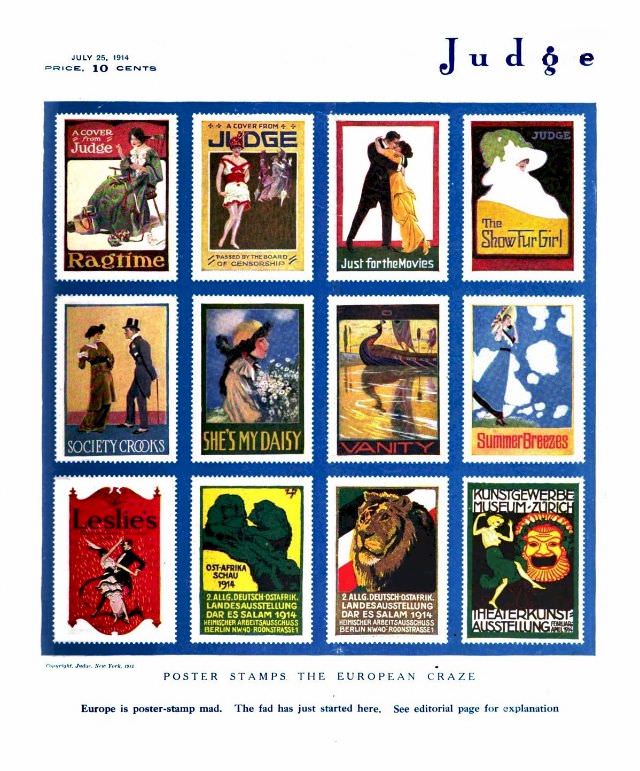
Judge magazine’s July 25, 1914 cover leans into a playful obsession with “poster stamps,” presenting a neat grid of vivid, stamp-like mini posters against a crisp blue border. At the top, the masthead and the ten-cent price anchor the page firmly in its early-20th-century moment, while the colorful rectangles below mimic the look of collectible labels that were circulating widely in shops, theaters, and exhibitions. The result is part magazine cover, part miniature gallery—designed to catch the eye the way real stamps and posters did.
Across the set, silhouettes, bold type, and theatrical color blocks advertise the era’s popular amusements and consumer fantasies: ragtime, “the movies,” summer imagery, society satire, and the allure of stage performance. Several designs feel distinctly European in flavor, mixing English titles with German-language text and museum or exhibition references, hinting at the international currents that fueled graphic design trends. Each “stamp” reads like a tiny billboard, distilled to a few striking shapes and words meant to be understood at a glance.
Beneath the grid, the caption “POSTER STAMPS: THE EUROPEAN CRAZE” frames the cover as both commentary and curiosity, capturing a fad in motion rather than a settled tradition. For collectors and design historians, this Judge cover art offers a compact survey of period advertising aesthetics—ornamental lettering, simplified figures, and punchy palettes—while also revealing how magazines packaged trend-spotting into something you could buy, save, and talk about. It’s a lively artifact for anyone searching Judge magazine covers, 1914 illustration, or early modern graphic design in print culture.