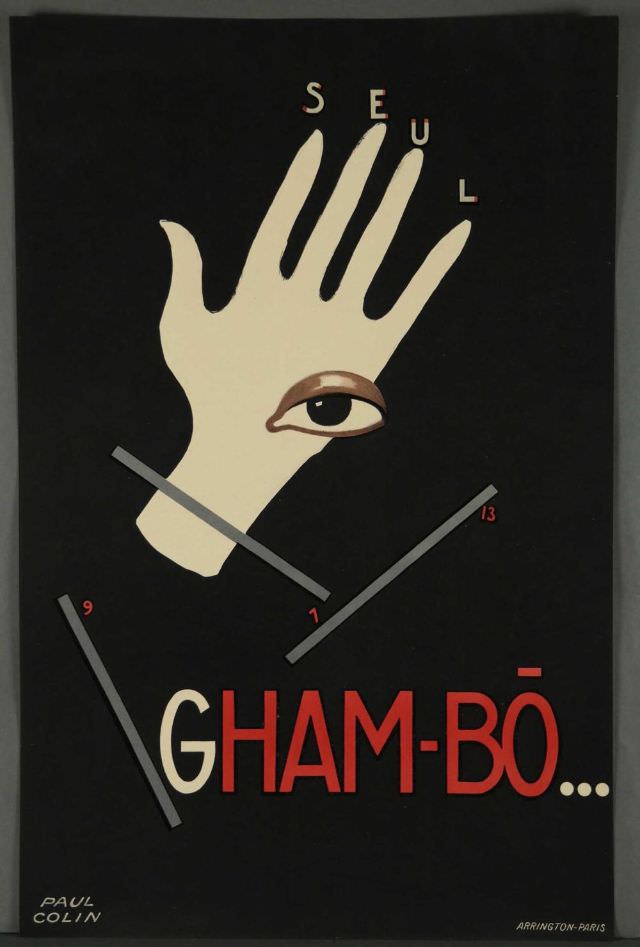
Bold geometry and a theatrical sense of mystery dominate this cover art for “Gham-Bo, circa 1930.” A pale, stylized hand rises out of a deep black field, its palm marked by a single watchful eye, while the word “SEUL” hovers above like a quiet verdict—alone. Slanted bars and small numbers cut across the composition, suggesting a clockwork rhythm or a coded message, and the title “GHAM-BŌ…” lands in striking red with an ellipsis that keeps the story open-ended.
The design feels rooted in the interwar modernist moment, when poster and book-cover artists embraced simplified forms, high contrast, and playful typography to grab attention at a glance. Here, the limited palette—cream, black, and red—makes every element do extra work, from the crisp letterforms to the sharp diagonals that create tension and motion. Even without a literal scene, the cover builds atmosphere through symbol: hand, eye, and time-like markers, blending the uncanny with the stylish.
For readers and collectors searching for 1930s cover art, early modern graphic design, or surreal poster aesthetics, “Gham-Bo” offers a compact masterclass in visual storytelling. It’s the kind of historical image that rewards a second look, inviting speculation about genre, mood, and meaning while remaining elegantly minimal. As a WordPress feature, it also serves as a vivid anchor for discussions of period typography, avant-garde illustration, and the enduring power of a well-designed cover.