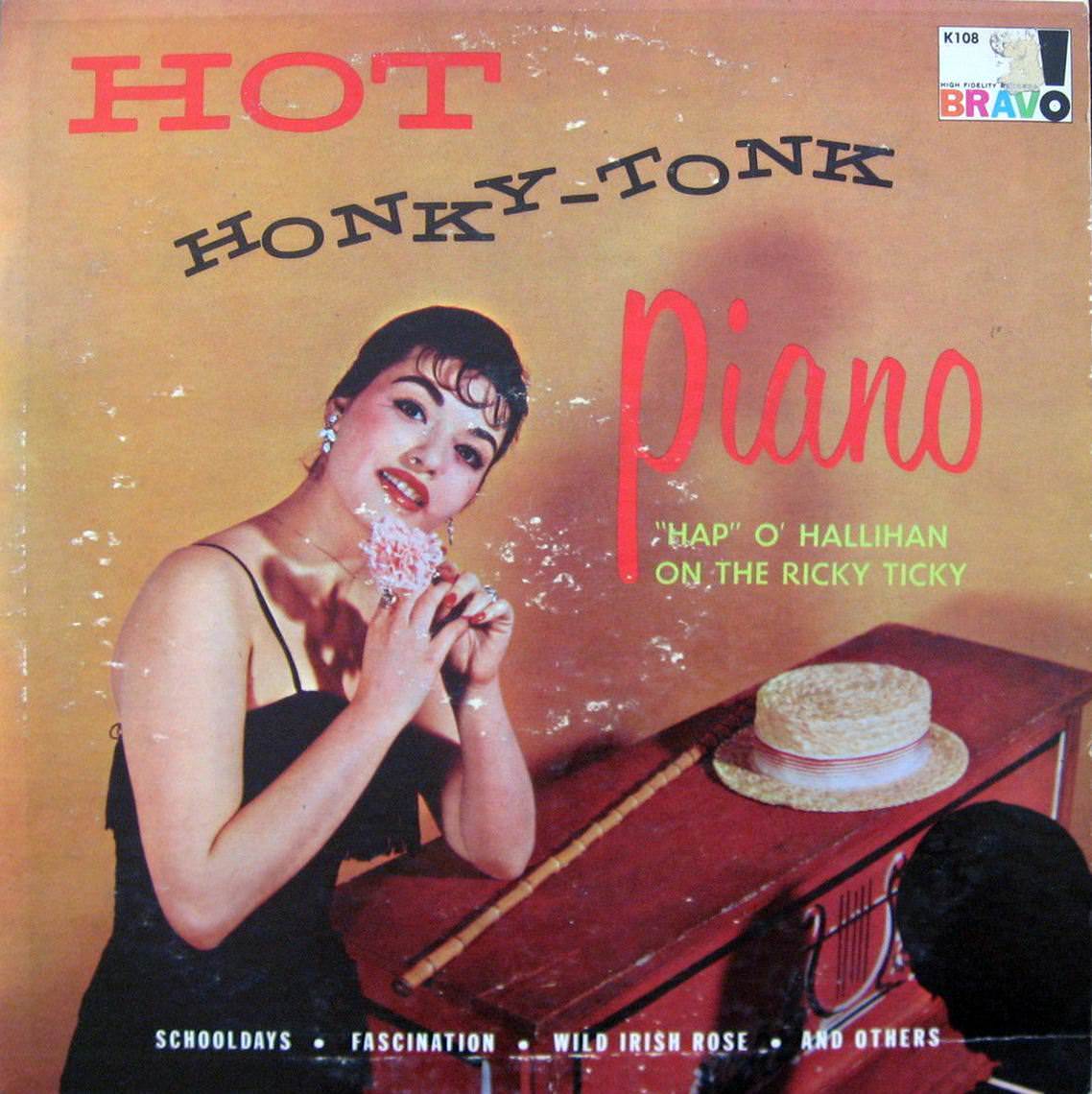
Hot honky-tonk piano gets sold here with a wink: big, bold lettering, a warm cocktail of tan and red, and a glamorous pose that feels halfway between nightclub stage and record-store dream. The cover shouts “HOT” and “HONKY-TONK” while the oversized “Piano” script leans into showmanship, promising lively barroom rhythm before the needle ever drops. Even the scuffs and wear on the sleeve read like proof of a hard-played favorite—handled, shelved, and pulled out again for one more round.
At the center, a pin-up styled performer in a black outfit smiles toward the viewer, holding what looks like a fluffy carnation-like accessory as if it were a mic or a bouquet between sets. A piano dominates the foreground, its lid turned into a makeshift tabletop where a straw boater hat rests beside a drumstick or cane-like prop—small details that hint at a rowdy room and a band ready to kick back into the chorus. In the corner, a “High Fidelity BRAVO” label and catalog marking “K108” anchor the design in the world of mid-century record branding and bargain-bin discovery.
Honky-tonk record cover art thrived on this kind of theatrical shorthand: glamour plus instruments, playful props, and typography that practically dances. The song list along the bottom—“Schooldays,” “Fascination,” and “Wild Irish Rose,” among others—suggests party standards and sentimental favorites refitted for rambunctious piano. For collectors, designers, and music historians, sleeves like this are time capsules of marketing, nightlife fantasy, and the irresistible promise of party tunes packed into a single LP.