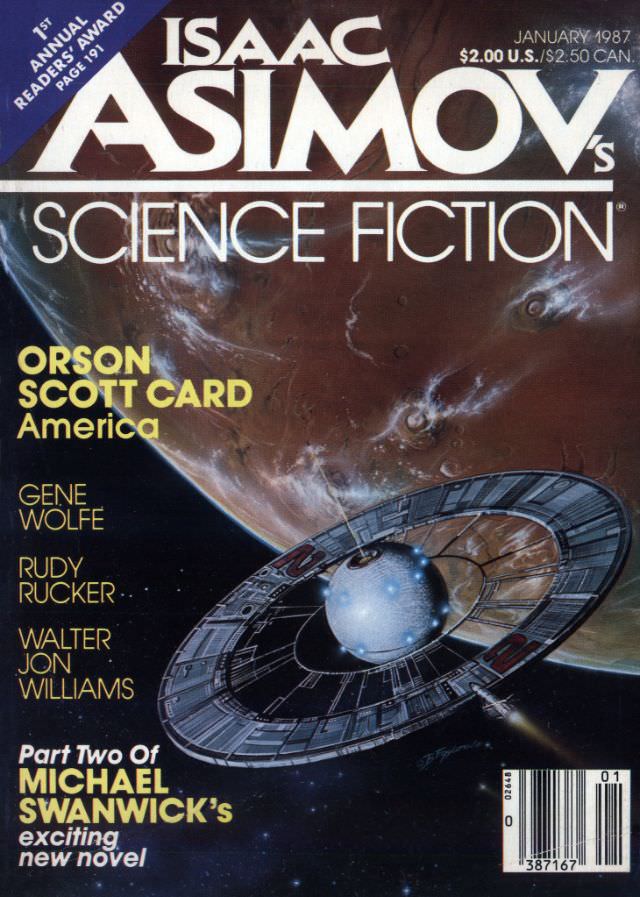
Bold, oversized typography announces ISAAC ASIMOV’S SCIENCE FICTION across the top of the January 1987 cover, with the issue price printed in the corner and a ribbon noting the magazine’s annual readers’ awards. The design balances clean, high-contrast lettering with a richly rendered space-scape, a classic approach that made newsstand science fiction magazines instantly recognizable. Even before you read a single line, the layout signals a confident, mainstream era of print sci‑fi culture.
A massive planet dominates the background, its clouded surface tinted in warm browns and reds, while a ring-like spacecraft or station drifts in the foreground around a luminous central sphere. The art leans into late–20th-century optimism about engineered habitats and deep-space travel, using light glints and shadowed panels to give the structure weight and scale. That combination of cosmic distance and mechanical detail is exactly the kind of visual promise that pulled readers toward the genre in the 1980s.
Featured names on the cover include Orson Scott Card, Gene Wolfe, Rudy Rucker, and Walter Jon Williams, along with a teaser for part two of a Michael Swanwick novel—an enticing snapshot of the magazine’s literary moment. For collectors and researchers, details like the month stamp, pricing, and barcode anchor the artifact in its original retail life, making it more than just “cover art.” As a piece of science fiction magazine history, this issue serves as a vivid portal into what editors marketed, what readers expected, and how speculative worlds were sold at a glance.