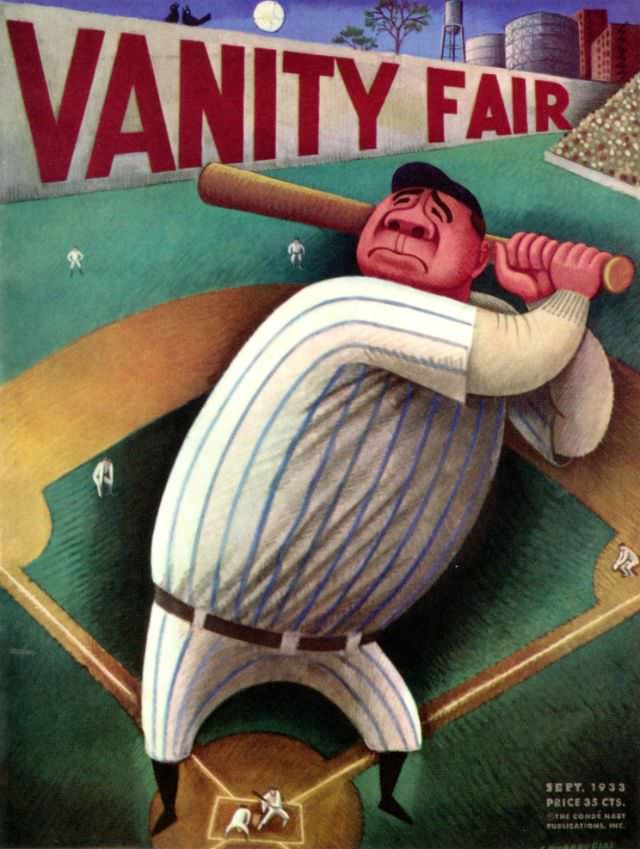
Bold block letters spelling “VANITY FAIR” loom over a stylized ballpark, while a hulking batter in a pinstriped uniform fills the foreground, bat cocked as if the next swing might shake the stadium. The artist exaggerates scale for comic impact: tiny fielders scatter across the green diamond, and the crowd reads as a dense, shimmering pattern in the stands. At the lower corner, the cover’s small print anchors the artwork in its magazine context—September 1933—an era when illustration still defined the look and feel of popular periodicals.
In the background, industrial shapes—tanks, a water tower, and factory-like structures—rise beyond the outfield wall, hinting at the modern city’s presence just outside the game. That juxtaposition gives the scene a wry edge: America’s pastime staged alongside the machinery of everyday life, with the oversized slugger turning sport into spectacle. The palette and simplified forms echo early-20th-century design trends, where bold color fields and caricature conveyed mood faster than fine detail.
As cover art, this Vanity Fair image works on two levels: it celebrates baseball’s drama while gently poking fun at the outsized personalities the sport creates. The batter’s strained expression and monumental posture suggest pressure, bravado, and showmanship—qualities that sold magazines as effectively as they sold tickets. For collectors and historians of magazine covers, the September 1933 Vanity Fair cover offers a vivid snapshot of how illustration, humor, and American culture met on the newsstand.