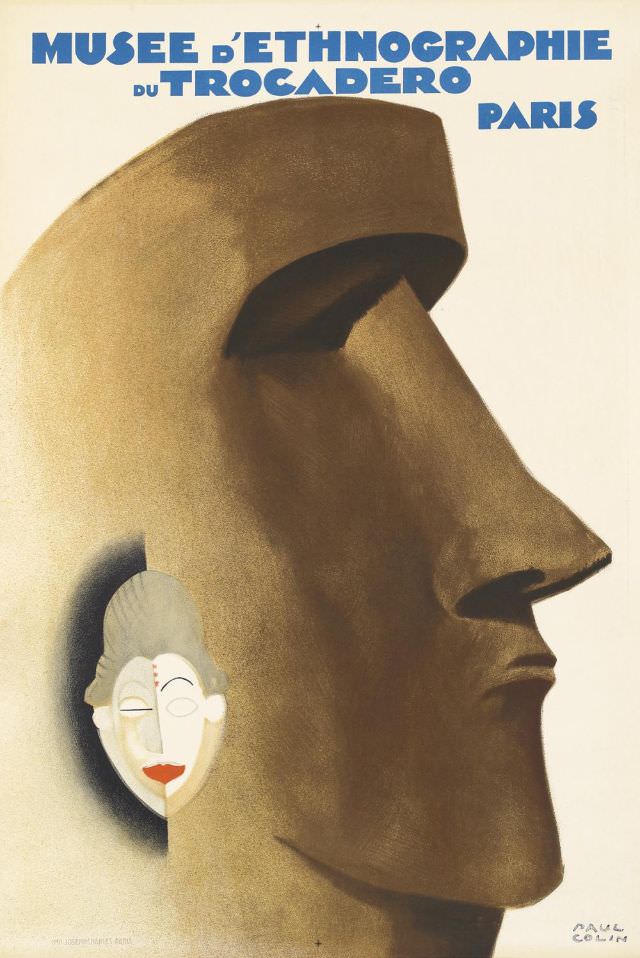
Bold lettering announces “Musée d’Ethnographie du Trocadéro, Paris,” while a monumental profile—calm, sculptural, and almost architectural—dominates the composition. The warm, airbrushed tones and crisp contours give the poster a distinctly early-20th-century graphic elegance, turning a museum advertisement into a piece of modern design. Even at a glance, the layout guides the eye from the title to the face, suggesting the authority and allure that ethnographic collections held in the interwar years.
Near the lower left, a smaller mask appears like an apparition against the large head, its pale surface, red lips, and narrow features standing out sharply from the surrounding browns and creams. Presented as a “Punu mask” in the title, it functions here both as an object of study and a visual emblem—portable, enigmatic, and instantly recognizable within the poster’s theatrical framing. The contrast in scale feels intentional: the mask is the focal treasure, while the oversized profile becomes a stage for looking, collecting, and interpreting.
For readers interested in museum history, ethnographic art, and vintage French poster design, this 1930 cover image offers a telling snapshot of how institutions promoted their collections to the public. It balances sleek modernism with the promise of distant cultures, reflecting the period’s fascination with “the other” as seen through European display practices. As a WordPress feature image or gallery highlight, it’s rich in atmosphere and searchable detail—Musée d’Ethnographie, Trocadéro, Paris poster, and Punu mask—while leaving space for deeper discussion of context and meaning.