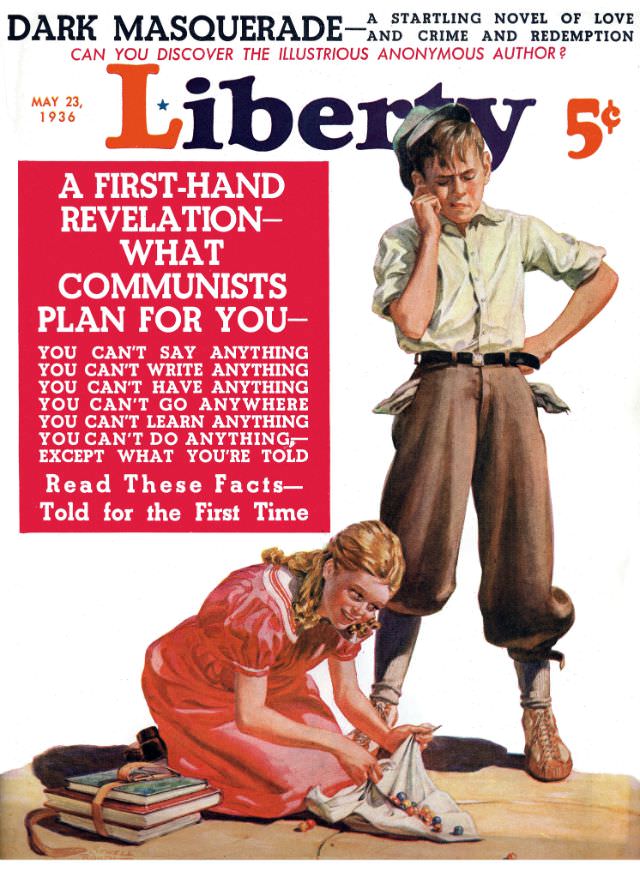
Bold headline typography and a striking red text block dominate the Liberty cover dated May 23, 1936, pitching a “first-hand revelation” about what “communists plan for you.” The design leans hard into urgency, stacking short, forceful lines that read like a warning poster, while the familiar Liberty masthead anchors it as mainstream newsstand fare. Even the small “5¢” price marker and teaser copy at the top (“Dark Masquerade”) help recreate the crowded, competitive world of 1930s magazine publishing.
At the center, an illustrated scene adds emotion to the political messaging: a boy stands with his hand to his face, looking troubled, while a girl kneels beside a small pile of books and spilled marbles, gathering them back into a cloth. Their clothing and posture suggest an everyday, youthful moment interrupted—domestic, vulnerable, and deliberately relatable. The contrast between the soft, storybook realism of the figures and the blunt, poster-like rhetoric of the text turns the cover into both narrative illustration and argument.
Collectors and readers interested in American magazine cover art, interwar politics, and period graphic design will find plenty to study in this issue. The language presents communism as an all-encompassing threat—“you can’t” repeated like a drumbeat—revealing how fear, persuasion, and mass-market media blended on the eve of global upheaval. As a historical artifact, this Liberty cover offers a window into how ideology was packaged for the public in 1936, marrying compelling illustration with hard-edged editorial promotion.