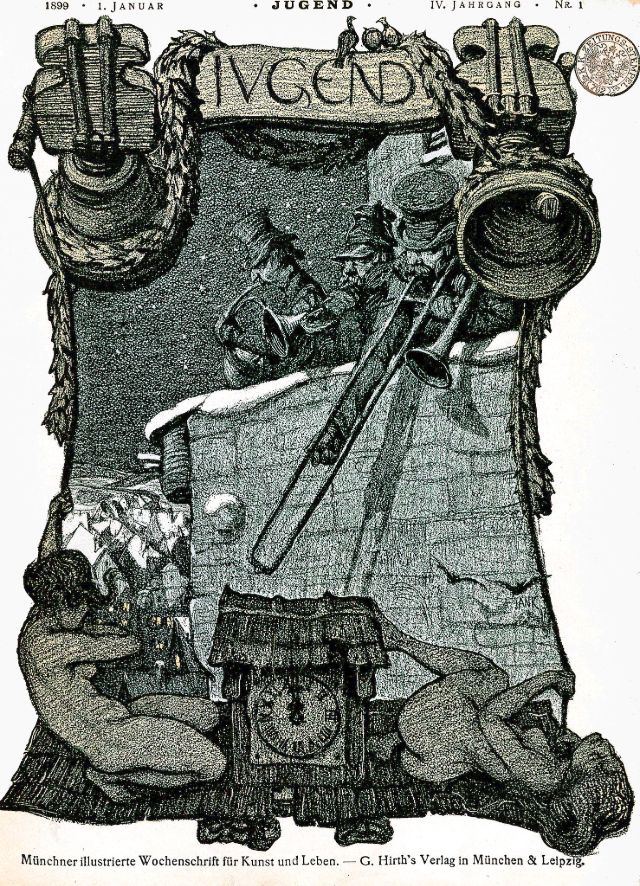
Bold lettering across the top announces “JUGEND” and “1. Januar 1899,” framing an ornate cover that feels both festive and slightly theatrical. Heavy garlands drape from the corners like stage curtains, while the border is packed with finely rendered objects—scrolls, decorative bundles, and dense linework that rewards a closer look. As cover art, it immediately signals a magazine interested in design, illustration, and the visual flair that defined turn-of-the-century print culture.
At the center, a bundled-up figure in winter clothing braces a trombone, its long slide cutting diagonally through the composition. Below, a clock face anchors the scene with a reminder of time and the turning of the year, while additional props—suggesting celebration, domestic comfort, and performance—spill into the margins. The effect is a lively collage: music, ornament, and the new-year moment woven together in a distinctly late-19th-century graphic style.
Printed details along the bottom identify it as a “Münchner illustrierte Wochenschrift für Kunst und Leben,” linking the issue to Munich’s illustrated press and its audience for art and everyday culture. For WordPress readers browsing Jugend magazine covers, German Jugendstil imagery, or historical magazine design, this January 1899 page offers a richly symbolic entry point. It’s a snapshot of how a periodical could turn a simple date on the calendar into an elaborate visual story about season, sound, and modern taste.