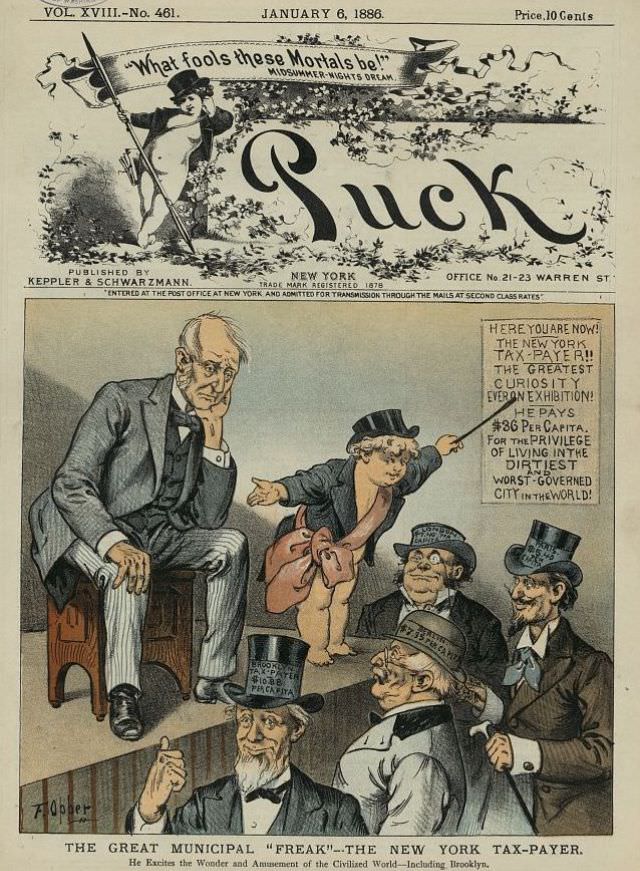
January 6, 1886 finds Puck leaning hard into its signature blend of theater and civic complaint, pairing bold lettering with a stage-like cartoon packed with recognizable types. Up top, the magazine’s masthead and pricing details frame the issue like a playbill, while the banner quotation (“What fools these mortals be!”) signals that satire—not reverence—is the lens through which readers are meant to view the scene below.
At center, the “New York tax-payer” is treated as a municipal spectacle, posed and prodded as if displayed for public amusement. A small, loud figure points and declaims in a speech bubble about the cost per capita and the “dirtiest” and “worst-governed” city, turning taxpayer frustration into a kind of sideshow patter. The cluster of well-dressed men in hats, smirking and watching, amplifies the cover’s accusation that respectable society can be complicit in dysfunction even as it pretends to diagnose it.
Beneath the humor sits a sharp piece of Gilded Age political commentary: the city as “exhibition,” governance as performance, and the ordinary payer as both victim and attraction. For anyone searching Puck magazine cover art, 1880s political cartoons, or New York municipal corruption satire, this issue offers a vivid snapshot of how illustrated journalism translated policy grievances into memorable characters. The composition, captioning, and exaggerated body language make the critique legible at a glance, which is exactly why these covers still read as powerful visual history.