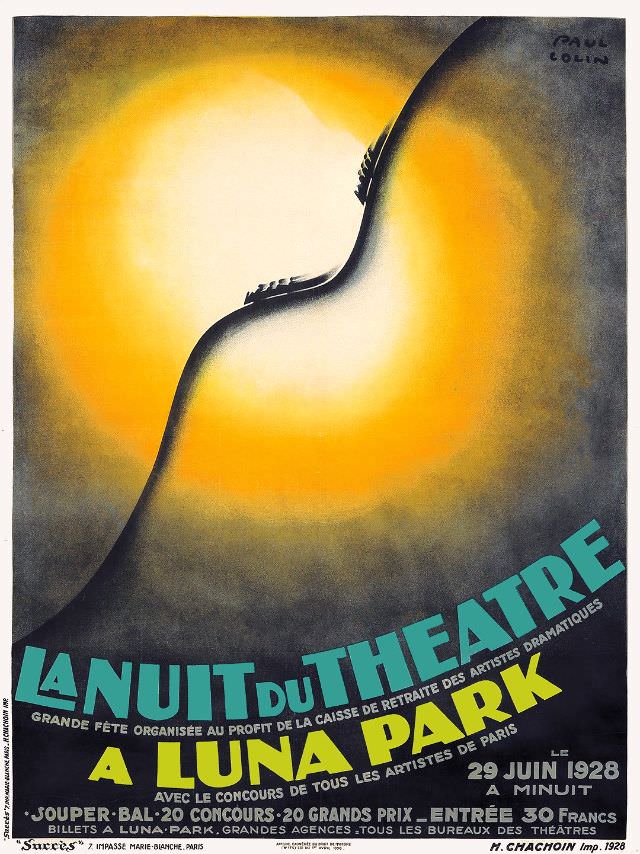
A blazing halo of yellow and orange floods the page, turning the central silhouette into pure theatre—an elegant curve that reads at once as stage, body, and spotlight. The composition feels unmistakably late‑1920s in its modernist confidence: minimal lines, dramatic contrast, and a sense of movement created by light alone. Even before you read a word, the artwork sells an evening built on glamour, anticipation, and the promise of performance after dark.
Bold, oversized lettering anchors the lower half, where “La Nuit du Théâtre” and “À Luna Park” announce the event like a shout across a bustling boulevard. Smaller lines of French text hint at a large public fête, with attractions and practical details presented in the brisk, persuasive language of entertainment advertising. The result is both a striking cover art piece and an artifact of how Parisian nightlife was packaged—graphic design doing the work of a marquee.
Dated 1928 in the title and on the poster itself, this print is a vivid window into interwar visual culture, when posters competed fiercely for attention with color, geometry, and typographic swagger. For collectors and researchers, it offers rich keywords—French poster art, Art Deco design, theatre night, Luna Park—while remaining a captivating image in its own right. It’s the kind of ephemera that survives not just as promotion, but as a lasting memory of an era’s taste for spectacle.