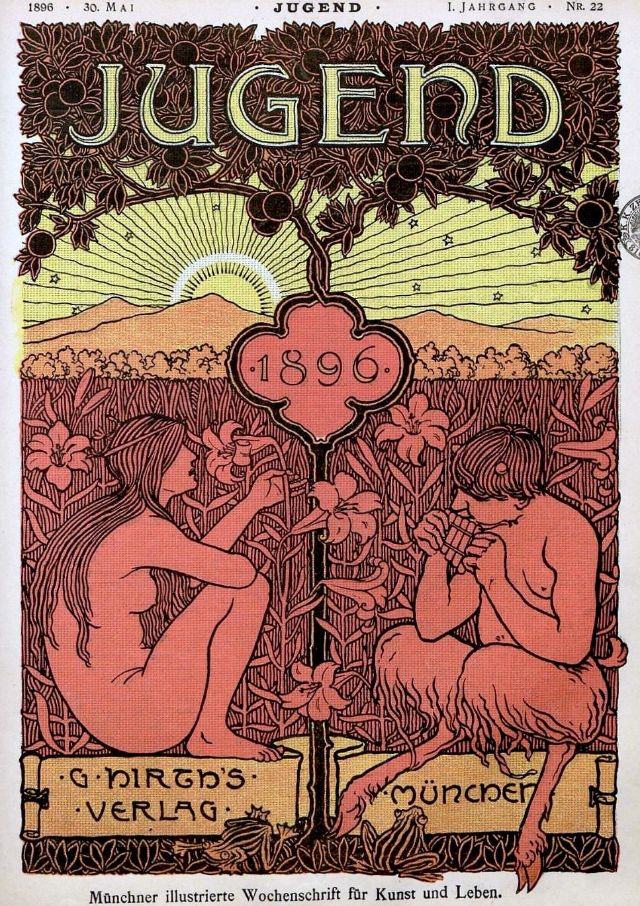
Across the top, the bold title “JUGEND” sits within a dense canopy of stylized leaves and berries, instantly signaling the ornamental spirit that would come to define turn-of-the-century design. Below it, a sunrise fans out over distant hills while the central cartouche reads “1896,” anchoring the composition like a seal on a poster. The palette of warm reds, creams, and deep browns gives the cover art a printmaker’s richness, with every line pushing the eye downward into the scene.
In the foreground, two nude youths crouch amid tall grasses and large, simplified blossoms, their bodies rendered with the same flowing contours as the plants around them. One figure holds flowers near the face, as if smelling or studying them, while the other leans forward in quiet attention, creating a gentle sense of dialogue without words. This merging of human form and natural pattern reflects the era’s fascination with nature as both subject and structure, where decoration and meaning are inseparable.
Printed details at the margins—“30. Mai,” “I. Jahrgang,” and “Nr. 22”—mark it as a specific issue of the Munich illustrated weekly “für Kunst und Leben,” and the lower text references “Münchner” and “Verlag.” As a piece of Jugend magazine cover art from 1896, it’s an evocative artifact for anyone searching Art Nouveau graphics, German design history, or period illustration. The composition balances intimacy and symbolism, suggesting youth not as a portrait of individuals, but as a season of life framed by the rhythms of the natural world.