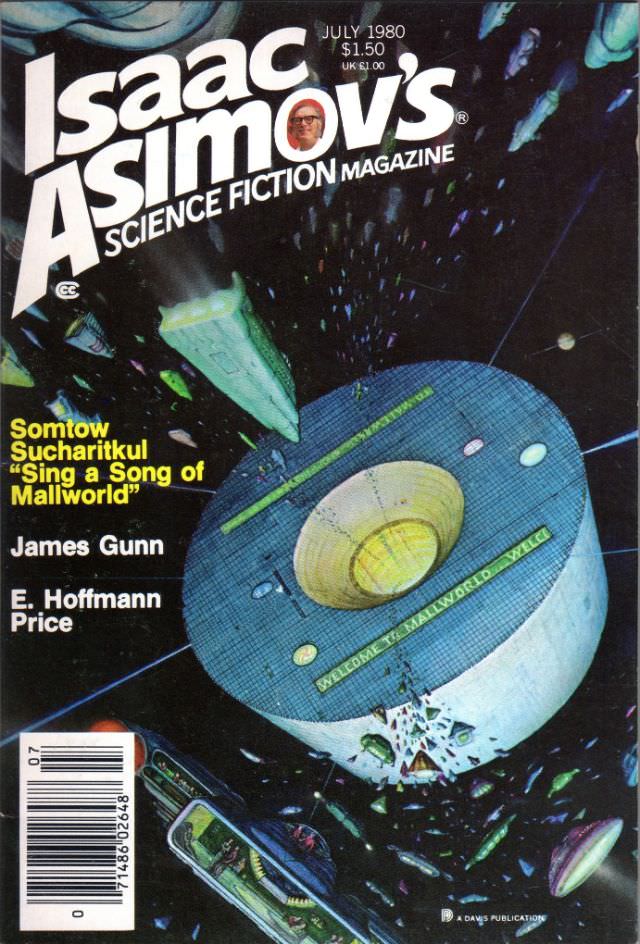
July 1980 arrives in bold, slanted lettering across the top of Isaac Asimov’s Science Fiction Magazine, with the cover price tucked neatly beside it. Against a star-splashed black, a huge wheel-like space habitat dominates the scene, its surface patterned with tiny structural details that suggest both engineering precision and lived-in scale. The typography and layout feel unmistakably of their era—confident, busy, and designed to catch an eye from across a newsstand.
At the center, the station’s circular form frames a glowing hub, while smaller craft and debris streak diagonally through the surrounding space, creating motion and a hint of danger. A green strip on the station reads “WELCOME TO MALLWORLD,” turning the illustration into a narrative hook: a spaceborne destination that promises commerce, crowds, and the strange intimacy of everyday life transplanted beyond Earth. Color choices—cool blues and greens punctuated by warm light—give the artwork a crisp, high-adventure sheen typical of late-20th-century science fiction cover art.
Along the left margin, story credits spotlight Somtow Sucharitkul’s “Sing a Song of Mallworld,” alongside names like James Gunn and E. Hoffmann Price, grounding the spectacle in the magazine’s role as a gateway to new and classic voices. For collectors and readers, this Asimov’s cover is also a snapshot of how science fiction marketed wonder in the 1980s: big concepts, clear stakes, and a world you can almost step into. Whether you’re browsing for vintage sci-fi magazine covers or tracing the visual history of space habitats in popular art, this issue stands as a vivid piece of genre ephemera.