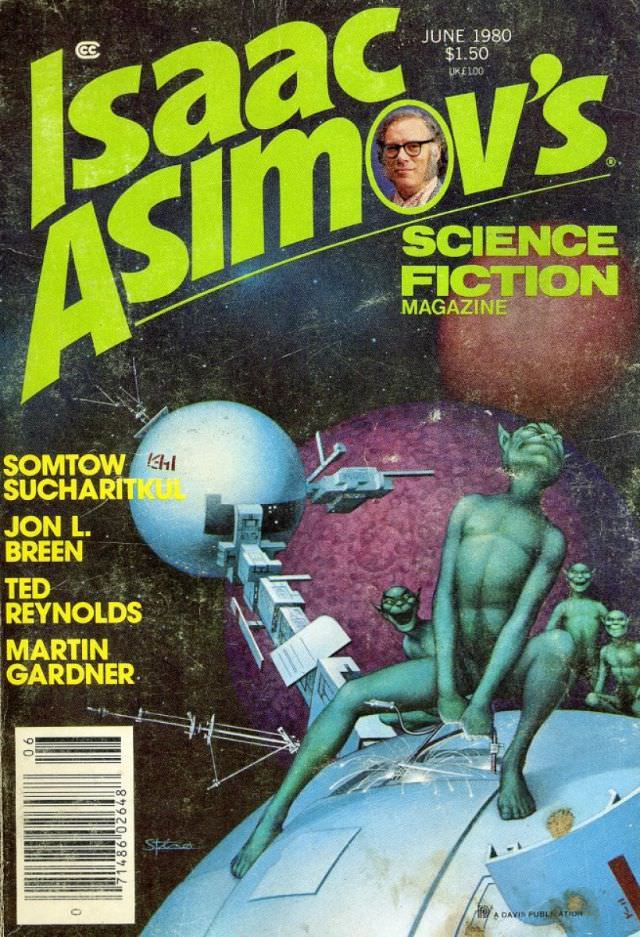
Lime-green lettering shouts “Isaac Asimov’s” across the top of this June 1980 cover of *Asimov’s Science Fiction Magazine*, with the issue’s price and date tucked into the corner and a small portrait cameo set into the masthead. Against a deep, speckled starfield, the layout balances bold typography with classic pulp-era clarity, making the magazine instantly legible even at a glance. The left column lists featured contributors—Somtow Sucharitkul, Jon L. Breen, Ted Reynolds, and Martin Gardner—anchoring the artwork in the editorial culture of early 1980s science fiction publishing.
A surreal tableau unfolds below: green-skinned, humanoid figures gather on and around a sleek, metallic structure that reads like a spacecraft hull or futuristic platform. One central figure sits in a theatrical pose, head tilted upward as if basking in alien light, while smaller companions linger nearby, watching. In the background, a white spherical module and angular docking elements stretch into space, adding a sense of engineered scale and off-world habitation.
Printed ephemera like this is more than “cover art”—it’s a snapshot of how science fiction sold wonder at the newsstand, mixing human forms, speculative architecture, and cosmic color into a single promise of strange stories inside. The palette leans into teal skin tones and violet shadows, evoking the era’s fascination with the alien as both beautiful and unsettling. For collectors and readers alike, this June 1980 *Asimov’s Science Fiction* cover stands as a vivid reminder of the magazine’s role in shaping genre taste, visual language, and the broader history of sci-fi illustration.