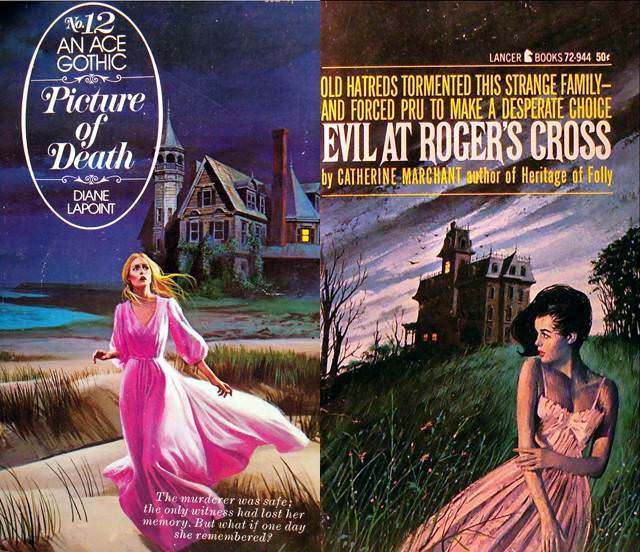
Moonlit mansions loom over windswept grass while two heroines, dressed in flowing nightgowns, turn their bodies away from the house as if the architecture itself has become a threat. On one side, a blonde woman in a vivid pink dress moves across a marshy shoreline, her hair and hem tugged by an unseen wind; on the other, a dark-haired woman crouches in the foreground, glancing back toward a steep-roofed estate on a hill. The covers announce their stakes loudly—titles like “A Picture of Death” and “Evil at Roger’s Cross” sit alongside taglines about hatred, memory, and desperate choices—making the home both landmark and menace.
Gothic romance cover art leans on a simple but powerful visual riddle: why is she outside, and why is she running? The house is drawn with sharp angles, towers, and glowing windows that suggest life inside yet offer no comfort, turning domestic space into a psychological trap. Readers are invited to project fear onto those lit windows and to read the woman’s posture—half-flight, half-hesitation—as the moment when suspicion hardens into certainty, or when love and danger become indistinguishable.
Few motifs sell the genre as efficiently as a woman fleeing a house, because it stages suspense in one glance and promises revelation in the next chapter. The night sky, the stormy color palette, and the high contrast between delicate clothing and rough landscape all heighten vulnerability while hinting at inner resilience. For anyone interested in vintage paperback history, these gothic romance covers offer a compact lesson in marketing emotion: danger is architectural, memory is unreliable, and the path away from the house is never as simple as it looks.