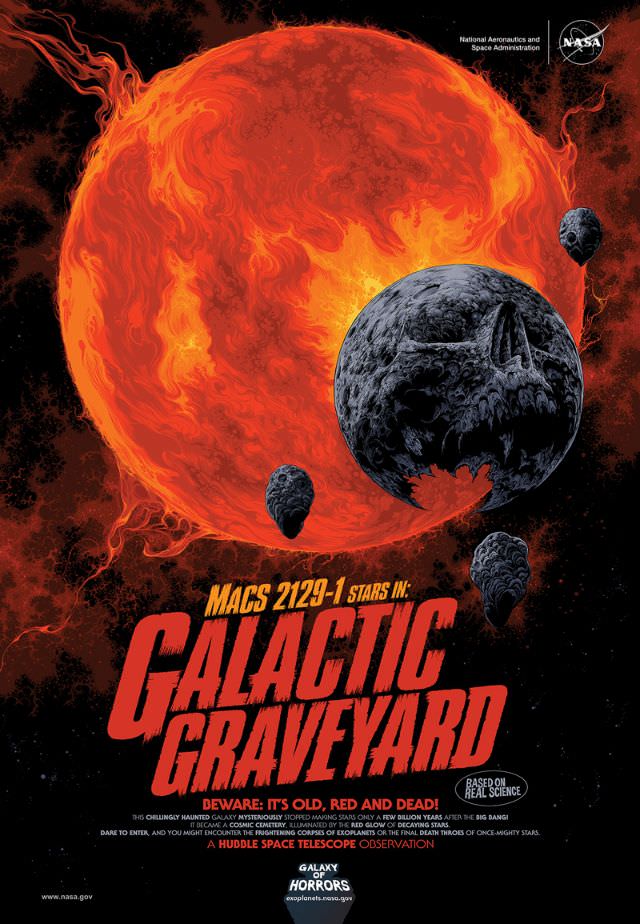
A blazing red star dominates the cover art for “Galactic Graveyard,” its turbulent surface rendered like living fire against a deep black sky. In the foreground, a dark, cratered world hangs in silhouette, while smaller, irregular bodies drift nearby like remnants left behind. The dramatic contrast of ember-bright light and ash-gray rock instantly evokes a sense of cosmic danger and finality.
NASA’s mark and the promise of “based on real science” point to the educational roots of this artwork, where graphic design meets astronomical storytelling. The composition leans on classic pulp sci‑fi poster energy—bold typography, looming planetary scale, and a central menace—yet it nods to genuine ideas about stellar evolution and harsh environments around dying or unstable stars. Even without a specific date or place, the visual language connects to space-age public outreach and the long tradition of turning telescope discoveries into compelling narratives.
“Galactic Graveyard” works as an SEO-friendly gateway into topics like red stars, exoplanets, cosmic debris, and the hazards of extreme radiation in space. The ominous planet-scape suggests a “cemetery” of worlds—burned, battered, or stripped by the star’s wrath—inviting readers to imagine what an observatory might infer from faint light and shadow. As cover art, it sells both wonder and warning: beauty at astronomical scale, and the cold reminder that not every world is built for life.