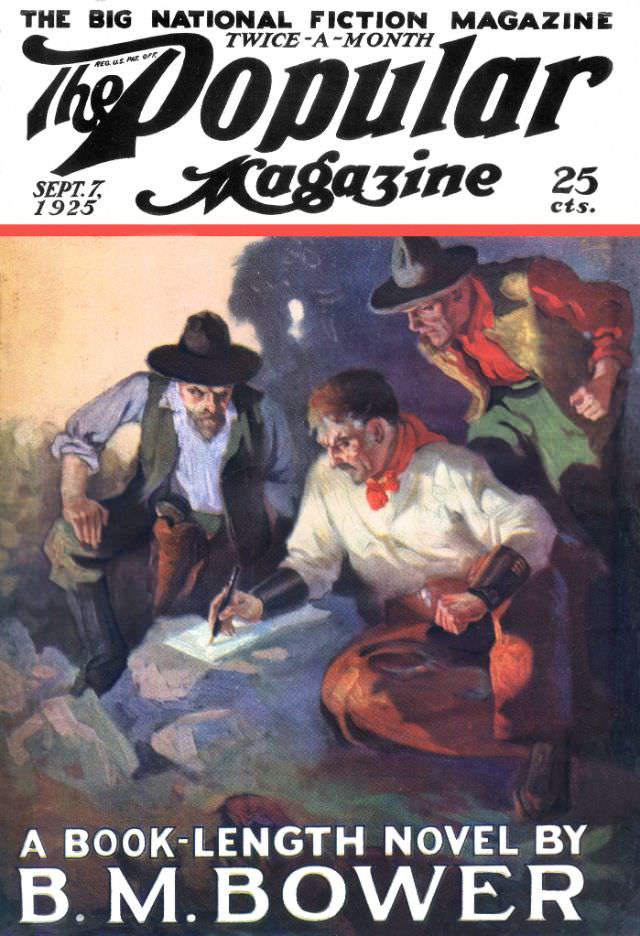
Bold lettering announces “The Popular Magazine,” billed as “The Big National Fiction Magazine” and issued twice a month, with the September 7, 1925 date and a 25-cent price printed prominently across the top. The typography itself is a period artifact—sweeping, confident, and designed to catch the eye on a newsstand—while the overall layout balances clean branding with a dramatic illustration below. Even at a glance, it signals the heyday of mass-market storytelling, when magazine covers served as both advertisement and miniature theater.
In the painted scene, three rugged, hat-wearing figures cluster amid rocks in what reads as a tense outdoor moment. One man crouches low, intent on writing on a sheet of paper, his gloved hand steady as the others lean in close, watching and waiting. The artist uses warm reds and browns against cooler shadows to heighten suspense, suggesting a hurried note, a decision being made, or evidence being recorded—exactly the kind of narrative hook that pulp and popular fiction magazines relied on.
Across the bottom, the promise of “A book-length novel by B. M. Bower” anchors the cover as more than a single story tease, pointing to the long-form adventures that kept readers coming back. For collectors and historians of early 20th-century print culture, this Popular Magazine cover art offers a vivid snapshot of how fiction was packaged, marketed, and imagined in 1925. It’s a reminder that before radio dramas and streaming series, a striking illustrated cover and a tantalizing premise were often all it took to launch a reader into another world.