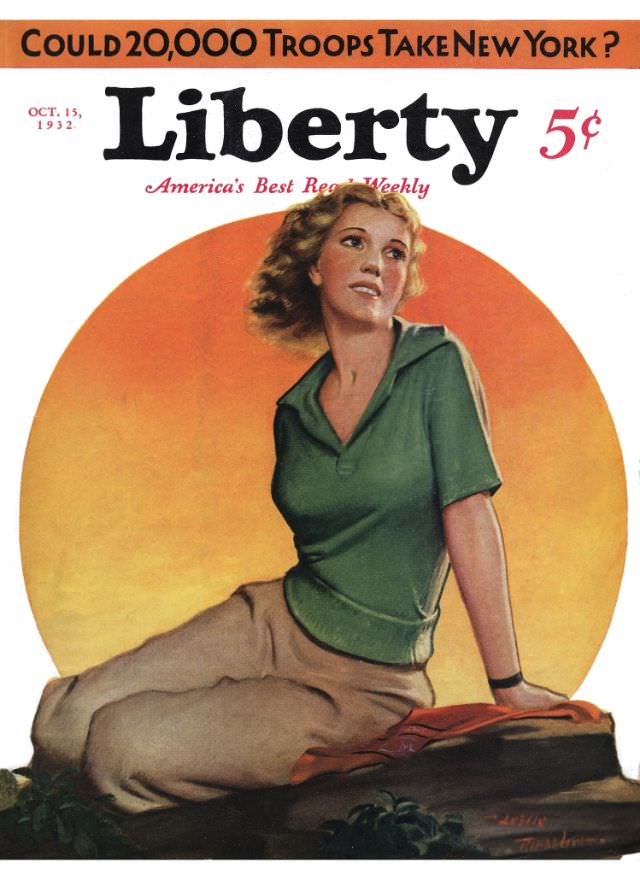
Bold typography and a provocative teaser headline frame the Liberty magazine cover dated October 15, 1932, priced at 5 cents and billed as “America’s Best Read Weekly.” The question splashed across the top—“Could 20,000 Troops Take New York?”—signals how mass-market periodicals hooked readers with high-stakes scenarios, mixing current anxieties with a sense of spectacle. Even before you reach the artwork, the design communicates urgency, confidence, and the big-city scale of the early 1930s American newsstand.
At the center, a poised illustrated woman reclines against a warm orange backdrop, her green blouse and light trousers rendered with smooth, painterly shading that feels distinctly of its era. Wind-tossed hair, a slightly averted gaze, and relaxed posture create a cinematic moment—part glamour portrait, part everyday modernity—suggesting the magazine’s knack for blending human interest with style. The limited palette and strong silhouette make the figure pop, a visual strategy meant to catch the eye from across a crowded rack of weeklies.
Browsing historical magazine covers like this Liberty issue offers more than nostalgia; it reveals how print culture packaged stories, politics, and aspiration for a broad audience during the Great Depression. Collectors and researchers value such cover art for its advertising-like clarity, its fashion cues, and its snapshot of editorial priorities, all captured in a single page. For anyone exploring Liberty magazine history, 1930s illustration, or classic American cover design, this October 15, 1932 cover is an especially striking example.