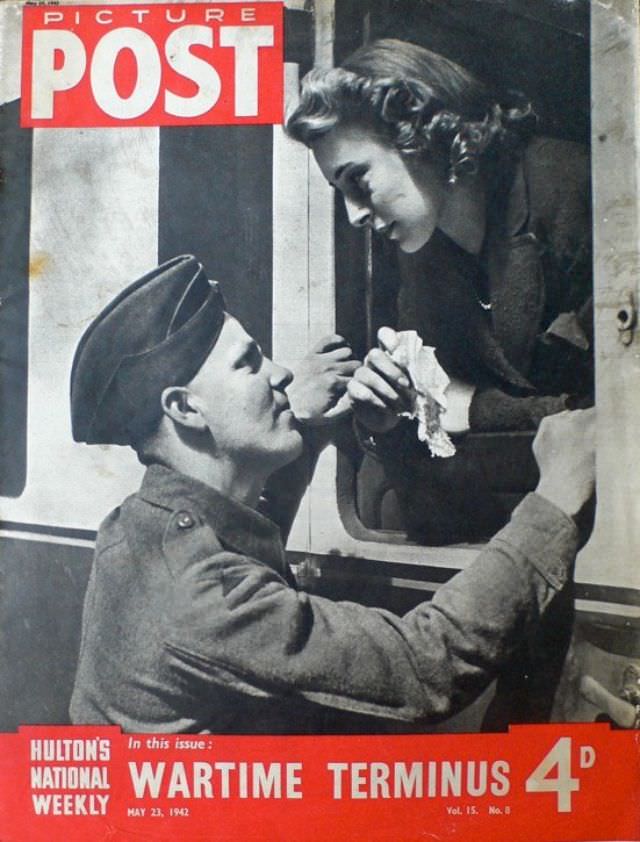
A bold “PICTURE POST” masthead frames a tender wartime moment: a uniformed serviceman stands on the platform beside a train, looking up as a woman leans out from the carriage window. Their hands meet at the edge of the compartment, her fingers clutching a small handkerchief or scrap of lace, the kind of everyday object that suddenly carries the weight of farewell. The cover line “Wartime Terminus” sets the scene as a station goodbye—intimate, urgent, and painfully familiar to anyone living through the travel, separation, and uncertainty of 1942.
The composition does what great photojournalism always tries to do, turning a public space into a private world. The carriage doorframe and window create a tight stage, trapping the couple in a rectangle of light and shadow while the rest of the station falls away. His cap and coat mark him as part of the war machine; her curled hair and dark coat speak to civilian life continuing under strain, meeting him halfway at the threshold.
As cover art for Picture Post (May 23rd, 1942), the image works as both reportage and emblem, distilling the home front into a single exchange of glances. For readers today, it’s a striking piece of WWII-era magazine history—useful for anyone researching wartime Britain, rail travel, military service, or the visual language of propaganda and morale. Even without a named station or identifiable unit, the scene remains instantly legible: a terminus where time runs out, and ordinary people try to hold on for one more moment.