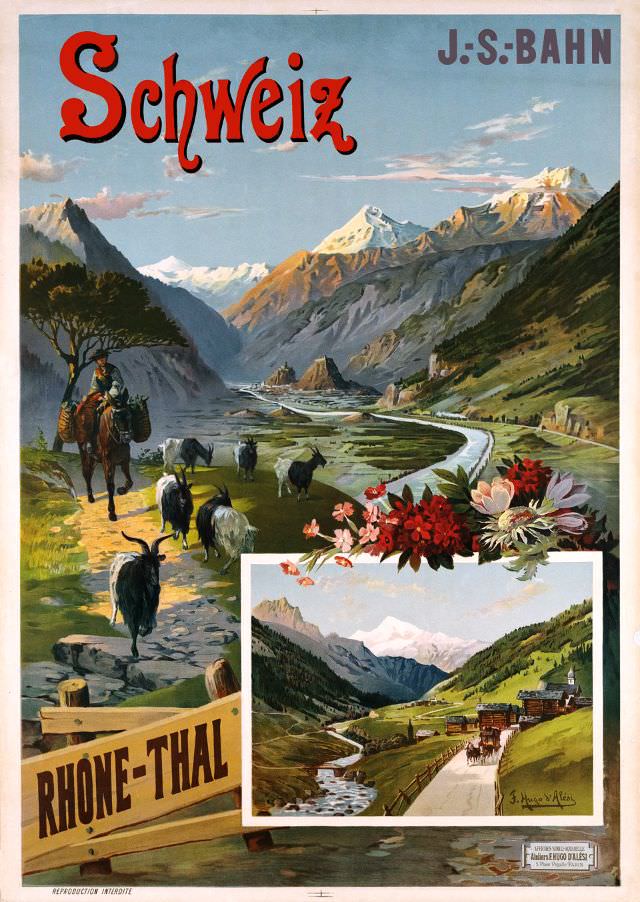
Bold lettering spells “Schweiz” across an Alpine panorama that feels both grand and inviting, a piece of cover art created to sell the romance of travel as much as the journey itself. The title points to the Rhône Valley and the Jura, while the mention of the Simplon Bahn anchors it in the age when railways were transforming Switzerland into a modern tourist destination. Snow-bright peaks, a broad sky, and a winding valley floor set the stage for a landscape meant to be admired from afar—and reached with increasing ease.
Along the left edge, a mounted herder guides goats down a sunlit path, a pastoral counterpoint to the engineered route that threads the valley below. The river bends through meadows and cultivated patches, leading the eye toward distant mountains where light and shadow articulate ridges and glaciers. Decorative alpine flowers and the poster’s carefully composed typography remind us that this is not a neutral document but a crafted advertisement, blending rural tradition with the promise of comfortable passage.
Near the bottom, an inset vignette adds another “postcard” view: a village scene in a green valley, with a road, clustered buildings, and a horse-drawn conveyance heading toward the peaks. Together, the main panorama and the smaller scene offer a travel narrative—mountain paths, river corridors, and human movement—designed to make the Rhône-Thal and surrounding regions unforgettable in a single glance. For readers interested in Swiss railway history, vintage Swiss travel posters, or the visual culture of 1890s tourism, this image is a vivid example of how the Simplon Bahn era marketed landscape as destination.