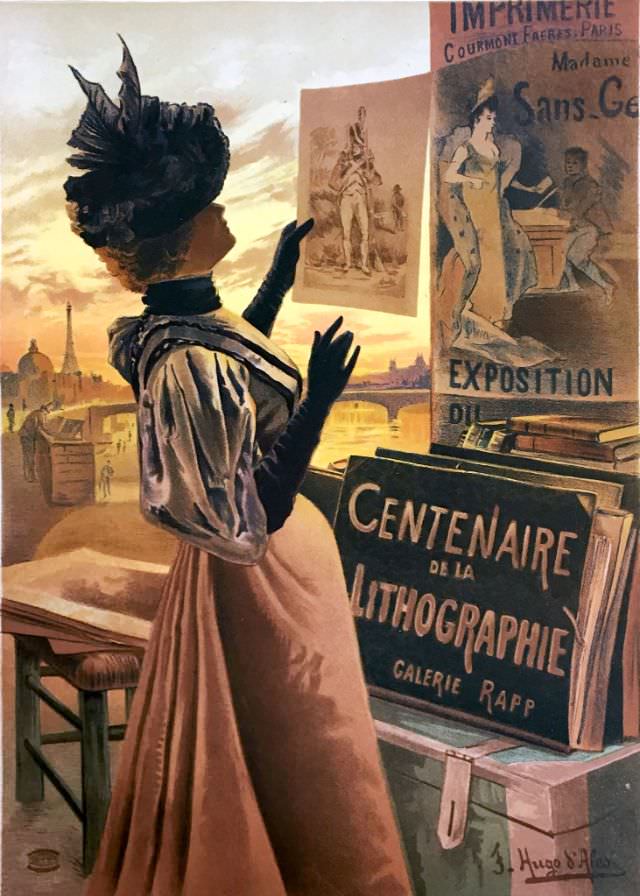
At the edge of a Parisian skyline at dusk, a fashionable woman pauses before a display of prints, her gloved hands lifted as if comparing tones and linework. The Eiffel Tower rises in the distance, anchoring the scene in the capital’s modern silhouette, while warm sunset colors bathe rooftops and river in a theatrical glow. It’s an elegant piece of cover art that immediately signals the city’s deep connection to graphic arts and public spectacle.
Bold lettering in the foreground announces the “Centenaire de la Lithographie,” with “Galerie Rapp” clearly visible, while stacked posters and sheets evoke the bustling world of printers, publishers, and exhibition-goers. The surrounding billboards—marked with “Imprimerie” and other partially legible text—create a layered street-corner museum, where advertising becomes art and art becomes advertisement. Even without a single spoken word, the composition tells a story about how lithography transformed visual culture through accessible, eye-catching images.
As a historical illustration tied to the 1897 exposition, this artwork doubles as a snapshot of fin-de-siècle taste: graceful dress, confident typography, and the romance of Paris framed as a marketplace of ideas. Collectors and design lovers will notice how the scene celebrates the craft itself—printmaking presented as a modern marvel, worthy of commemoration. For anyone searching for “Exposition du Centenaire de la Lithographie 1897” or vintage French poster art, the image offers a richly detailed gateway into the era’s print culture and exhibition life.