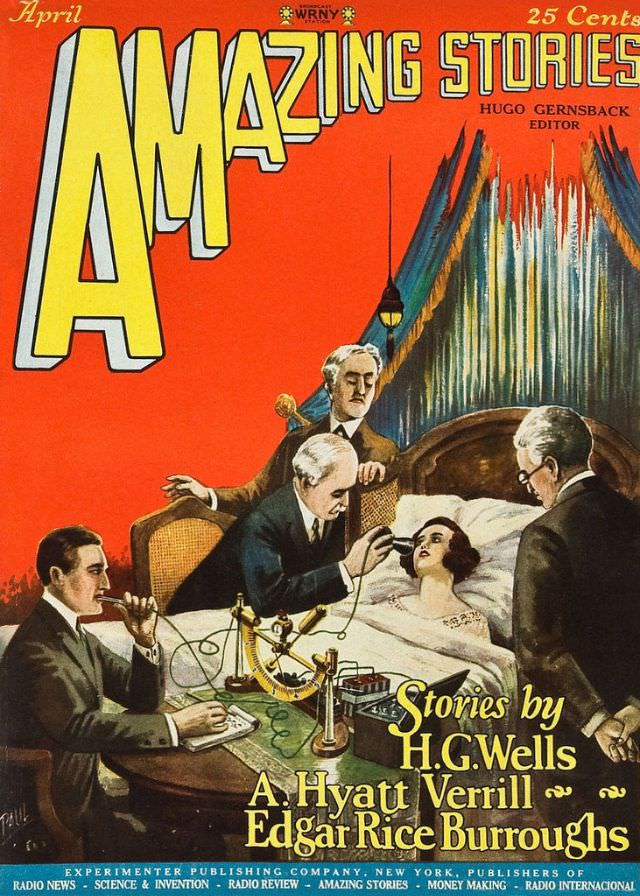
April 1927 arrives in a blaze of red-orange ink, with the towering “AMAZING” masthead daring the eye to look closer. Priced at 25 cents and edited by Hugo Gernsback, this Amazing Stories cover leans hard into the promise of modern wonder—bold typography, tight layout, and a stage-like composition designed to stop newsstand browsers in their tracks. Even before you read a single line, the artwork sells science fiction as something urgent, contemporary, and slightly dangerous.
At the center, a patient lies propped in bed while several suited men crowd in, their attention fixed on a web of wires and tabletop instruments. The scene feels half medical consultation, half laboratory demonstration: one figure appears to monitor or record observations while another brings a device toward the patient’s face, suggesting experimentation conducted with calm authority. Heavy drapery and lamplight frame the drama, giving the illustration a parlor-room realism that makes the speculative technology feel unnervingly plausible.
Names printed at the bottom—H. G. Wells, A. Hyatt Verrill, and Edgar Rice Burroughs—signal the magazine’s bid to be both entertaining and literary, a crossroads where adventure fiction and “scientifiction” met. For collectors and pulp historians, the April 1927 Amazing Stories cover is a vivid example of how early science-fiction magazines marketed the future: not as distant fantasy, but as a device you could place on a table, connect with cables, and test on the spot. As cover art, it doubles as cultural evidence, reflecting a 1920s fascination with radio-era electronics, expert knowledge, and the thin line between cure and experiment.