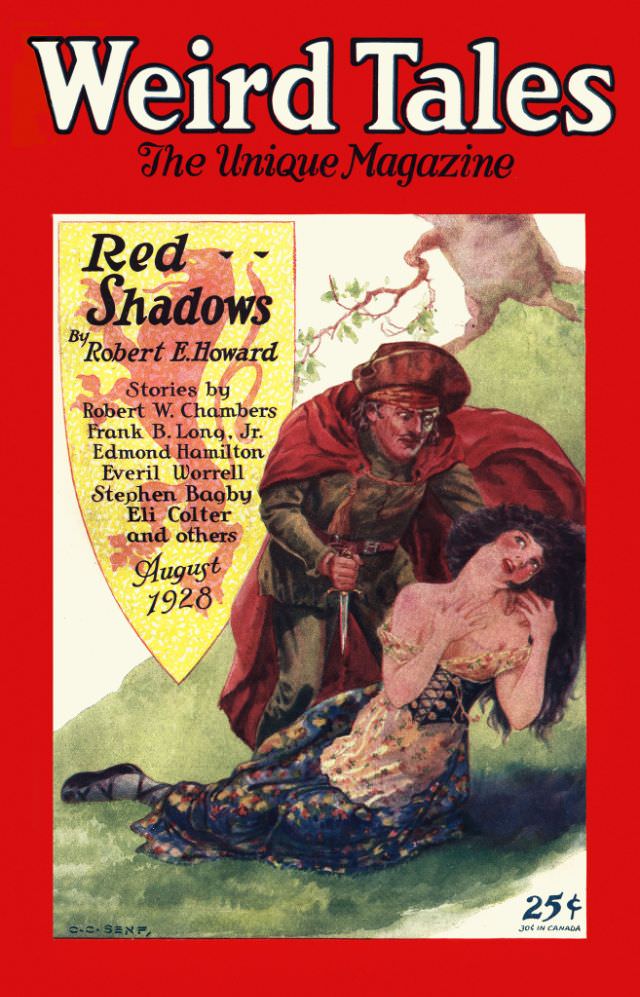
Bold red borders and towering letterforms announce *Weird Tales: The Unique Magazine*, the August 1928 issue, with cover art designed to arrest a passerby at the newsstand. A bright inset highlights “Red Shadows” by Robert E. Howard, while a roster of contributing writers—Robert W. Chambers, Frank Belknap Long, Jr., Edmond Hamilton, and others—signals the magazine’s role as a crossroads for early weird fiction. Even the printed price, 25¢, anchors the artwork in the commercial rhythms of the pulp era.
At the center, melodrama takes a dark turn: a cloaked figure looms with a knife in hand over a woman who slumps against the ground, her expression caught between fear and shock. The painterly scene leans on high contrast—deep crimson, heavy shadow, and the sweep of a cape—to evoke danger and forbidden romance in a single frozen moment. It’s the kind of sensational, story-in-a-glance composition that helped pulp magazines compete for attention in crowded stacks.
Collectors and genre historians return to covers like this because they reveal how horror and fantasy were packaged for mass audiences in the 1920s. Beyond the lurid theatrics, the typography, author billing, and dramatic illustration together map an early chapter in the visual language of supernatural fiction. For anyone searching for a *Weird Tales* August 1928 cover, Robert E. Howard “Red Shadows,” or classic pulp magazine art, this piece offers a vivid window into the era’s imagination.