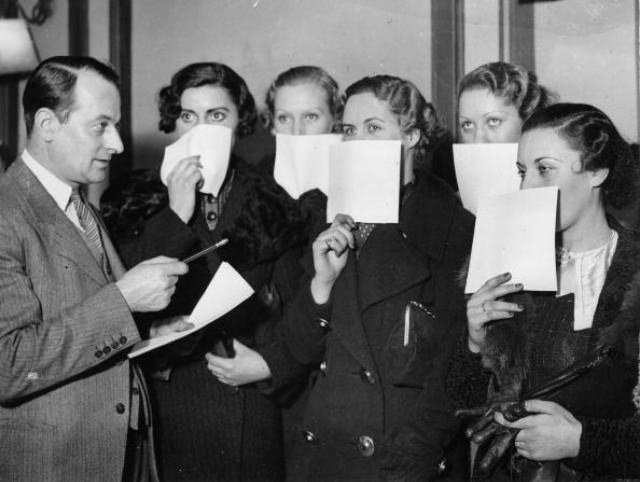
A well-dressed judge stands at the left with a notepad and pen, studying a line of contestants who hold sheets of paper up to their noses so only their eyes remain on display. The women’s carefully waved 1930s hairstyles and tailored coats set a distinctly interwar mood, while the improvised “mask” turns the gaze into the sole feature under consideration. With faces partially hidden, the composition draws attention to lashes, brows, and the different ways each participant meets the examiner’s scrutiny.
Behind the novelty lies a telling slice of 1936 fashion and culture in Britain, when beauty contests multiplied and magazines helped define what counted as modern femininity. A competition for “the most beautiful eyes” suggests both playfulness and precision, as if attractiveness could be isolated, measured, and ranked like any other commodity. The plain paper screens also hint at an era’s faith in judging systems—attempts to make something as subjective as beauty feel objective, scientific, and fair.
Expressions do much of the storytelling here: some eyes look straight ahead with practiced confidence, others glance sideways with a mix of nerves and curiosity. The judge’s poised stance and the contestants’ orderly grouping evoke a public event, likely staged for press coverage and the era’s appetite for unusual spectacles. As an SEO-friendly glimpse into 1930s Britain, the photo links beauty pageant history with interwar style, capturing how the decade’s ideals could be distilled into a single, unforgettable feature—the eyes.