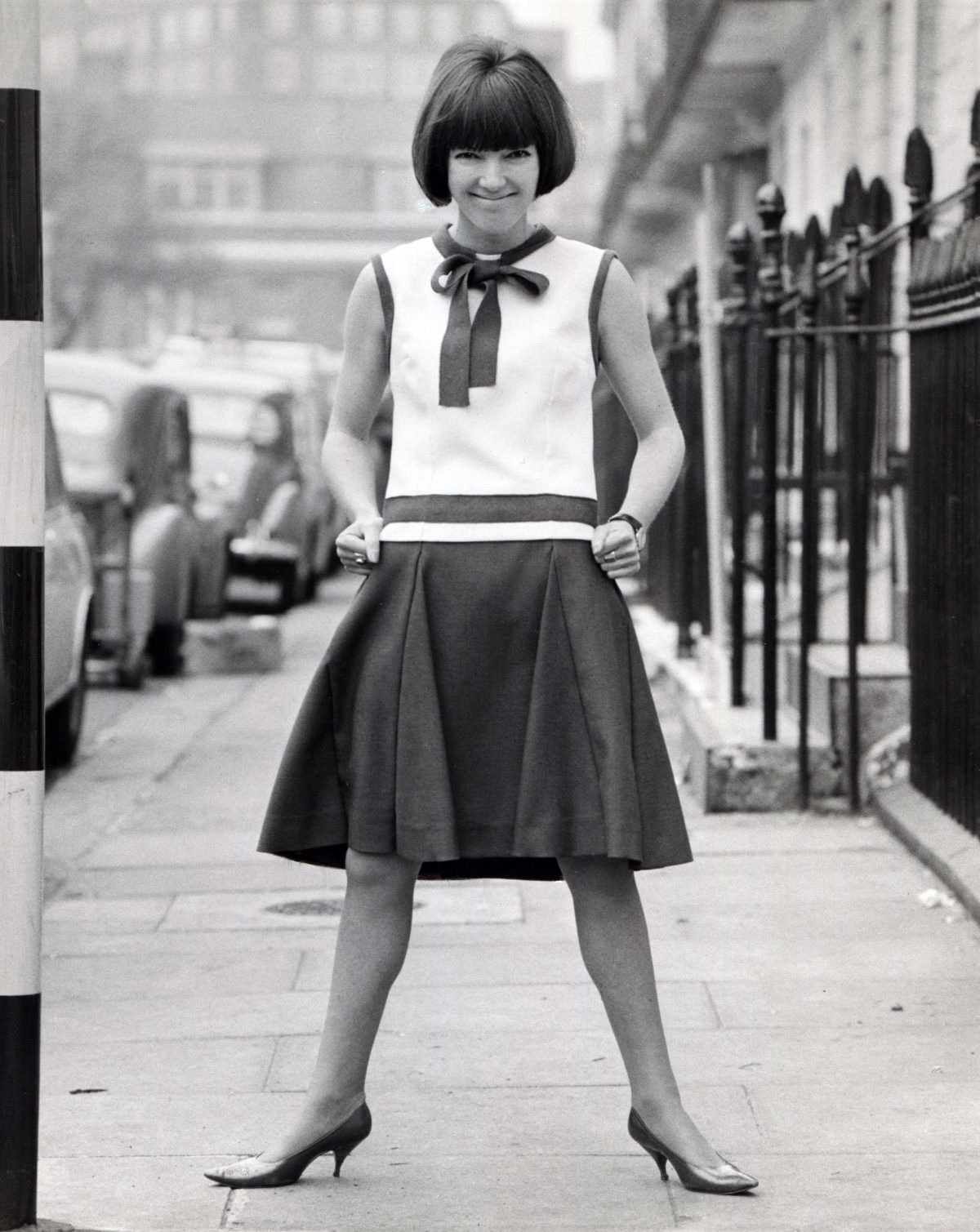
Mary Quant stands confidently on a city pavement in Vic Singh’s c1961 portrait, meeting the camera with a knowing smile and an unmistakably modern silhouette. Her neat bob frames her face like a graphic statement, while the sleeveless top with its bold bow and contrasting trim reads as crisp, youthful, and deliberately unfussy. With hands set at her hips and feet planted wide, she presents fashion not as decoration but as attitude—street-ready and self-possessed.
The outfit’s clean lines and above-the-knee skirt hint at the new pace of early 1960s style, when practical movement and playful geometry began to replace the constrictions of the previous decade. Behind her, parked cars and a soft blur of passersby situate the scene in everyday urban life, suggesting that the revolution in women’s dress was happening in public view rather than behind salon doors. Singh’s focus keeps Quant sharply in the foreground, turning a simple sidewalk into a stage for emerging Swinging London fashion culture.
As a piece of fashion history, the photograph resonates with the mythology of the King’s Road and the mini-skirt’s ascent, yet it also works on a quieter level as a study in image-making. The contrast between tailored blocks of light and dark fabric and the vertical rhythms of railings and buildings gives the frame a graphic snap, echoing the modernist spirit of the era. For readers searching Mary Quant photography, 1960s street style, and British fashion icons, this portrait offers a distilled glimpse of how a designer’s personal look could become a cultural signal.