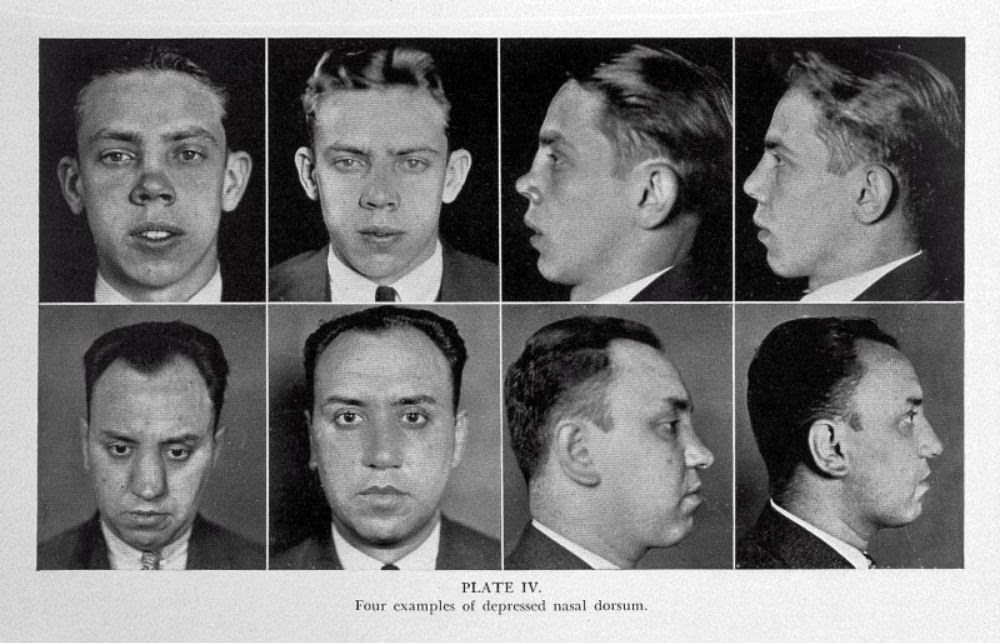
Arranged like a clinical contact sheet, the plate presents four men in paired views—front and profile—set against dark studio backdrops that keep attention fixed on facial structure. The composition feels closer to a medical record than a portrait: collars buttoned, hair neatly combed, expressions neutral, and the lighting even enough to emphasize the bridge and tip of the nose without dramatic shadow. Beneath the images, the printed caption identifies them as “four examples of depressed nasal dorsum,” a blunt anatomical label that hints at the period’s evolving vocabulary for cosmetic and reconstructive work.
In the 1920s and 1930s, rhinoplasty sat at the intersection of medicine, modern beauty standards, and the growing authority of photography as “proof.” These comparative angles were used to evaluate proportions and plan surgical correction, reflecting a time when surgeons increasingly documented faces with standardized poses. The result is a revealing glimpse of early plastic surgery culture—where the nose became a focal point for ideas about refinement, symmetry, and the promise of self-reinvention.
Fashion and culture hover at the edges of the frame, even in a strictly medical layout. The suits, ties, and grooming suggest middle-class respectability, while the very act of cataloging noses speaks to a decade hungry for modern solutions to old insecurities. For readers searching the history of rhinoplasty, early nose jobs, or 1920s–1930s cosmetic surgery, this stark plate captures the era’s mix of scientific confidence and social pressure, frozen in the careful logic of before-and-after documentation.