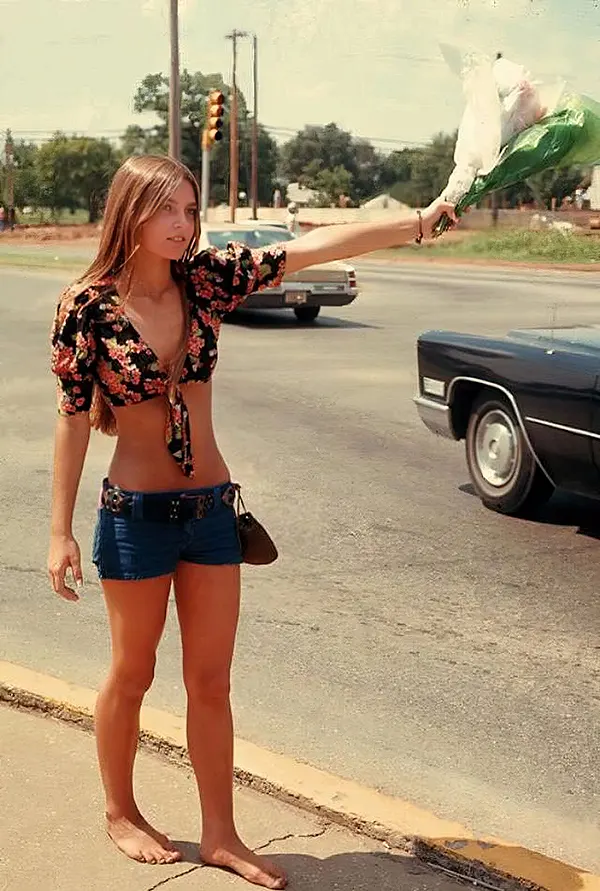
Under the hard Oklahoma sun in 1973, a young woman stands at the edge of the roadside with her arm extended, offering a wrapped bouquet toward the passing cars. She’s barefoot on the concrete curb, poised between the grit of the shoulder and the flow of traffic, as a traffic light and low suburban lines blur into the background. The moment feels candid and immediate, like a split second of everyday hustle paused for the camera.
Her outfit speaks fluently in the language of early-1970s style: a cropped floral blouse with a deep neckline tied at the front and short denim cutoffs that sit high on the hips. Long, straight hair frames her face in that unforced, natural look that defined the era’s beauty ideals, while a small shoulder bag hints at practicality amid the day’s improvisation. Even without a storefront or stand, the bouquet becomes her merchandise and her signal, transforming an intersection into a temporary marketplace.
Behind the fashion lies a quiet story about roadside economies and the informal work that thrived along American roads—especially in places where car culture shaped daily life. The composition makes automobiles and open asphalt part of the portrait, underscoring how commerce, youth, and mobility intersected in the 1970s. As a piece of vintage Americana, it remains searchable and striking for anyone interested in Oklahoma history, 1973 street photography, and the enduring influence of 1970s fashion and culture.