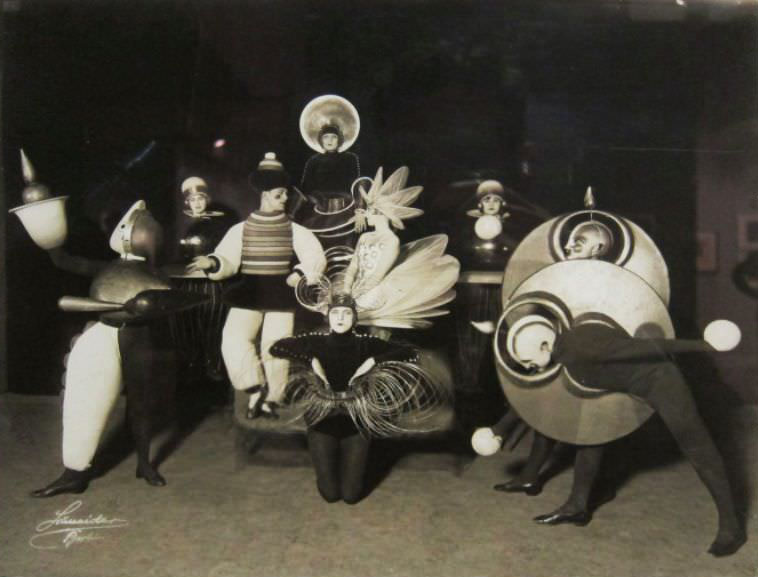
Under stage lights, a troupe of dancers appears less like a cast of individuals and more like a moving exhibition of modern design. Bulbous helmets, concentric discs, and oversized, sculptural costumes turn bodies into geometric silhouettes, echoing the daring visual language associated with avant‑garde theater in the Roaring Twenties. The dark background heightens the drama, letting the performers’ rounded forms and crisp contrasts read almost like cutouts in motion.
At the center, the eye is pulled between playful extremes: a figure kneeling with a spoked, skirt-like ring that radiates outward, while others stand behind in stacked circles and stripes that suggest mechanical toys or futuristic armor. Several costumes frame the face inside a halo or porthole, emphasizing anonymity and transforming expression into pure shape. Even in a still image, the arrangement implies choreography—group symmetry, staggered heights, and a sense of rotation and balance.
More than a novelty, the Triadic Ballet aesthetic reflects a moment when fashion, performance, and visual art blurred together, reimagining what dance could look like in an age fascinated by industry and abstraction. These daring designs prioritize form, rhythm, and composition over realism, making the stage a laboratory for geometry and color, even when rendered in monochrome. For historians of 1920s fashion and culture, the photograph stands as a vivid reminder of how modernism stepped off the canvas and onto the dance floor.