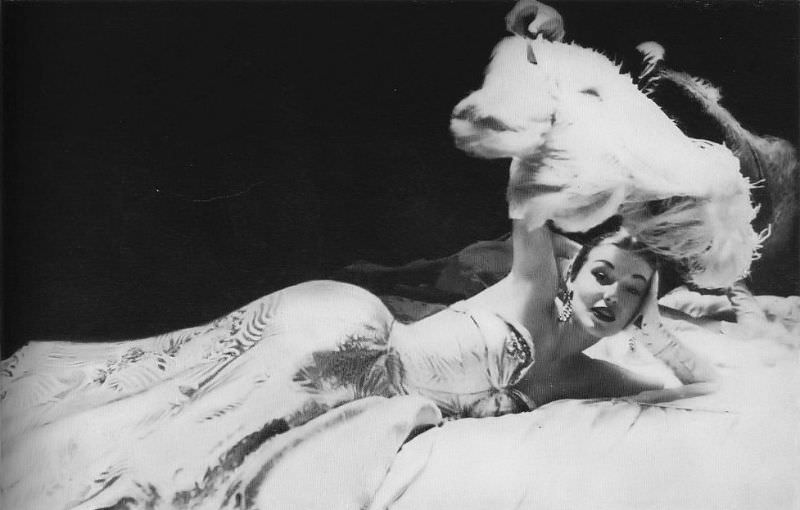
Reclining across a sweep of rumpled fabric, Liz Pringle wears a strapless evening gown that clings and glows under studio lighting, its white-and-gold satin print rendered in shimmering tones of gray. The bodice reads as sculpted and fitted, while the skirt stretches outward in a long, elegant line that emphasizes mid-century couture’s fascination with sleek glamour. Her jewelry and carefully styled hair complete the polished, magazine-ready look associated with Harper’s Bazaar fashion editorials.
Behind her, an oversized horse head prop rises from the darkness, turning the scene into a playful piece of surreal fashion theater. The contrast between the model’s poised expression and the animal’s monumental presence adds motion and wit, as if the set were designed to suggest speed, fantasy, and high-society spectacle all at once. Deep shadows and a minimalist background keep attention fixed on texture—satin sheen, printed patterning, and the soft highlights on skin.
Published in Harper’s Bazaar in October 1950, the photograph spotlights a Howard Greer design at a moment when postwar fashion celebrated drama, refinement, and editorial imagination. It’s both a style document and a cultural artifact, showing how couture photography could borrow from stagecraft to make a gown feel like an event. For anyone searching mid-century fashion photography, 1950s eveningwear, or Harper’s Bazaar vintage couture, the image stands as a memorable intersection of elegance and visual storytelling.