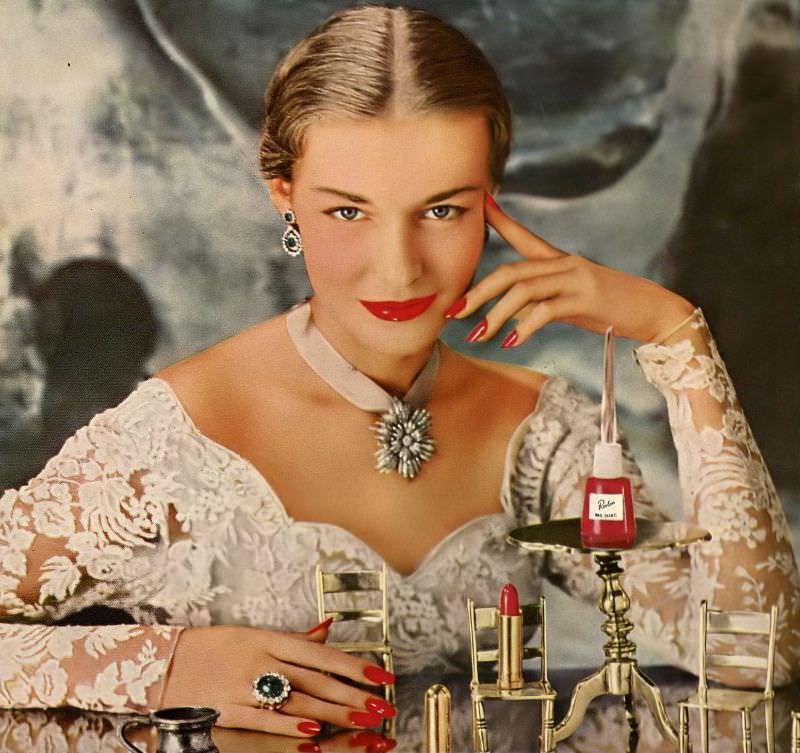
Poised with her chin lightly lifted and a knowing half-smile, model Liz Pringle meets the viewer’s gaze while her lacquered fingertips frame her face like punctuation. The styling is pure early-1950s glamour: sleek, center-parted hair, sparkling earrings, and a dramatic statement necklace set against an off-the-shoulder lace gown. Behind her, a softly swirling studio backdrop heightens the sense of polished sophistication associated with Harper’s Bazaar fashion pages.
Revlon’s makeup message is delivered with elegant clarity—red lipstick and matching nail enamel echo one another, turning coordination into the headline. On the tabletop, a lipstick stands upright like a miniature monument, while a nail polish bottle rises on a small stand, staged as if part of a jeweler’s display. The composition invites the eye to travel from Pringle’s vivid mouth to her immaculate manicure, reinforcing the era’s ideal of a perfectly “finished” look.
Published as an advertisement in Harper’s Bazaar’s September 1950 issue, the image sits at the intersection of postwar consumer culture and high-fashion editorial taste. It sells more than cosmetics; it sells an attitude of confident refinement, where beauty rituals are presented as modern luxuries worthy of careful presentation. For collectors and researchers of mid-century advertising, vintage Revlon marketing, and 1950s beauty trends, this piece remains a striking example of how glamour was staged, lit, and color-matched for print.