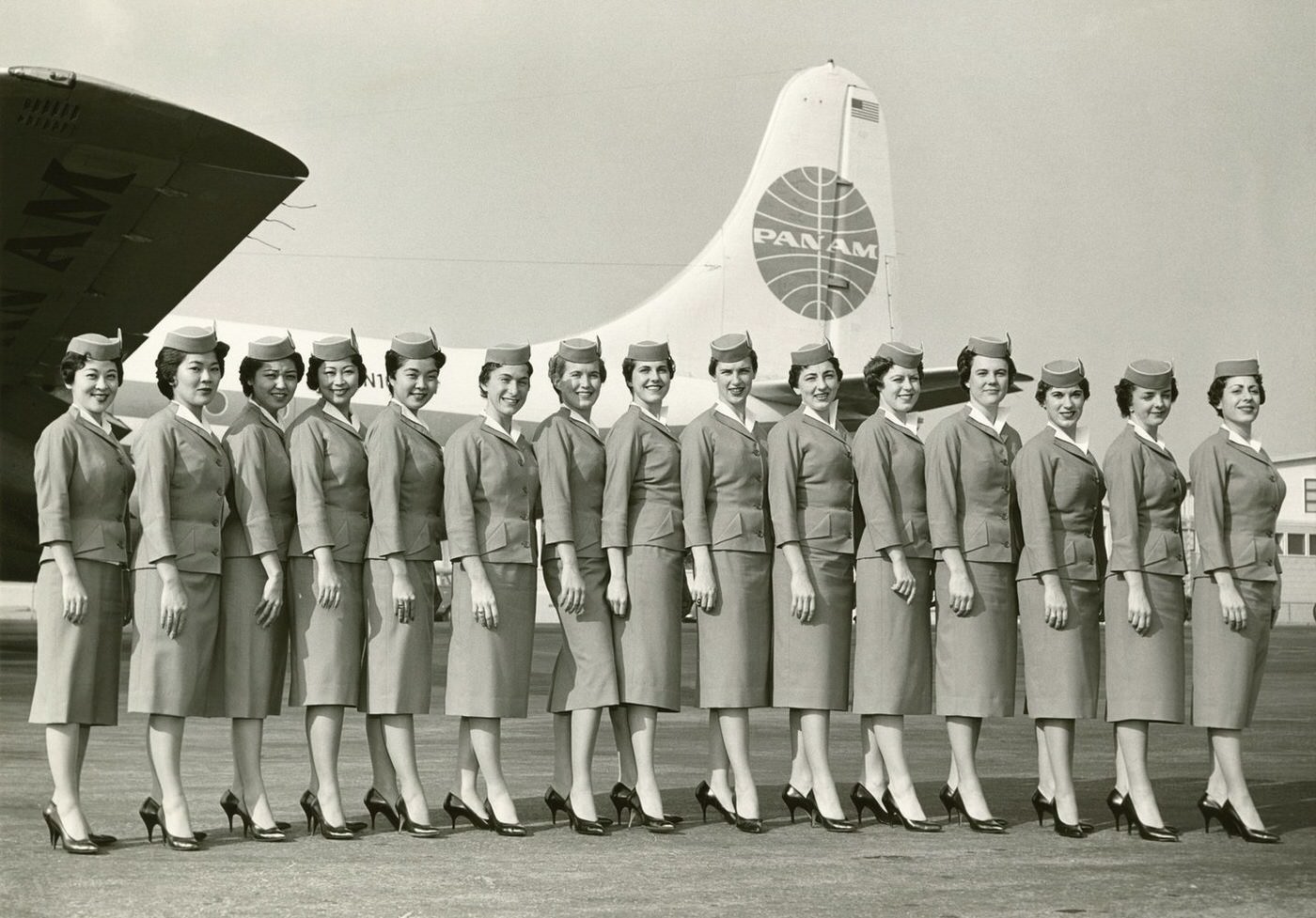
Lined up on the tarmac beneath the unmistakable Pan Am globe, a full row of flight attendants model the airline’s polished late‑1950s look, their matching pillbox hats and tailored skirt suits creating a near-military symmetry. The aircraft’s tail looms behind them like a billboard for the Jet Age, reinforcing how closely brand image and cabin service were intertwined. Even in a posed group portrait, the details read clearly: crisp lapels, fitted jackets, neat gloves-free hands, and dark heels meant to signal poise as much as practicality.
Designed by Don Loper in 1959, these Pan American uniforms sit at the crossroads of postwar couture and corporate identity, where “femininity and elegance” became part of the passenger experience. The silhouette is restrained rather than flashy—clean lines, structured shoulders, and a hem that moves with the era—yet it still feels aspirational, the sort of outfit meant to look impeccable in terminals, lounges, and press photos. For anyone interested in airline history, mid-century fashion, or the evolution of the flight attendant role, the image is a small lesson in how style was engineered to communicate trust, glamour, and modernity.
Collectors understand why pieces like these remain so desirable: they’re wearable artifacts from a time when air travel marketed itself as an event. Pan Am ephemera, especially uniforms tied to a named designer, carries the romance of long-haul routes and international sophistication, while also reflecting the strict grooming standards and presentation expected of women in the industry. As part of the wider story of flight attendant fashion from the 1930s to the 1970s, this portrait captures a brand at full confidence—elegance carefully measured, and displayed for the world to admire.