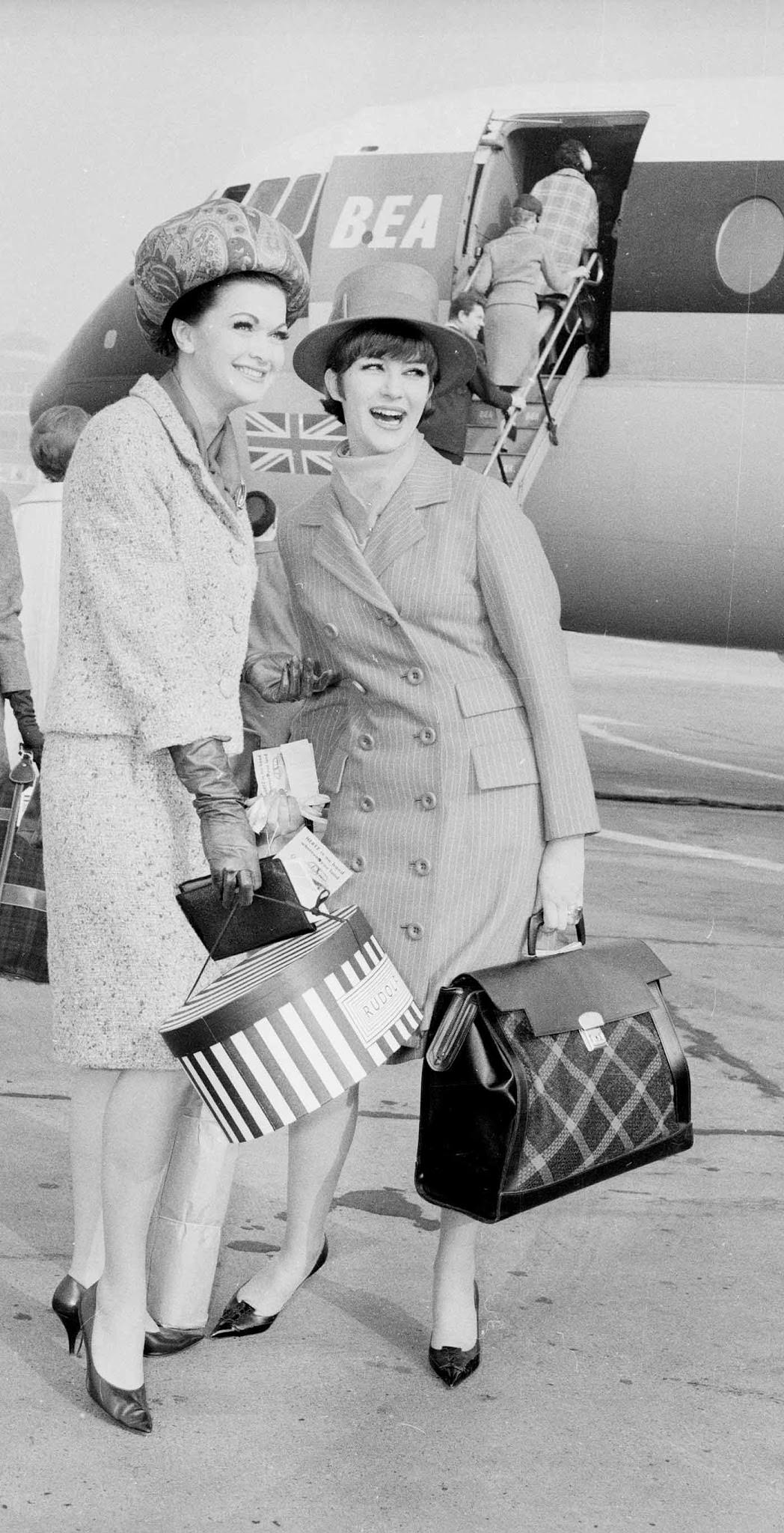
Laughter and runway wind set the tone as air hostesses Penny Gillard and Jackie Bowyer pause beside a BEA passenger plane, about to board for Paris in 1963. Behind them, the aircraft’s open door and a line of passengers climbing the steps anchor the scene in the everyday choreography of mid-century air travel, when boarding still felt like an event. The BEA lettering on the fuselage and the bright, forward-looking mood hint at an era when European routes promised speed, style, and a touch of continental glamour.
Their uniforms and accessories speak volumes about the shift from the old “Golden Age” polish to the Mod-era edge. Structured tailoring, neat hats, gloves, and smart heels create a silhouette built for the camera as much as for the cabin, while the patterned luggage adds a dash of personality amid the formal kit. Even in a candid moment, presentation is part of the job—proof of how airline branding and flight attendant fashion were intertwined in the early 1960s.
For readers drawn to aviation history, fashion history, and 1960s culture, this photograph offers a vivid snapshot of what it meant to fly BEA on the Paris route: professional, aspirational, and unmistakably modern. It also reminds us that travel once unfolded at a slower pace, where the tarmac served as a stage and a uniform could signal both service and status. Viewed today, Gillard and Bowyer stand not just as crew preparing for departure, but as icons of an age when air travel sold a lifestyle as surely as it sold a ticket.