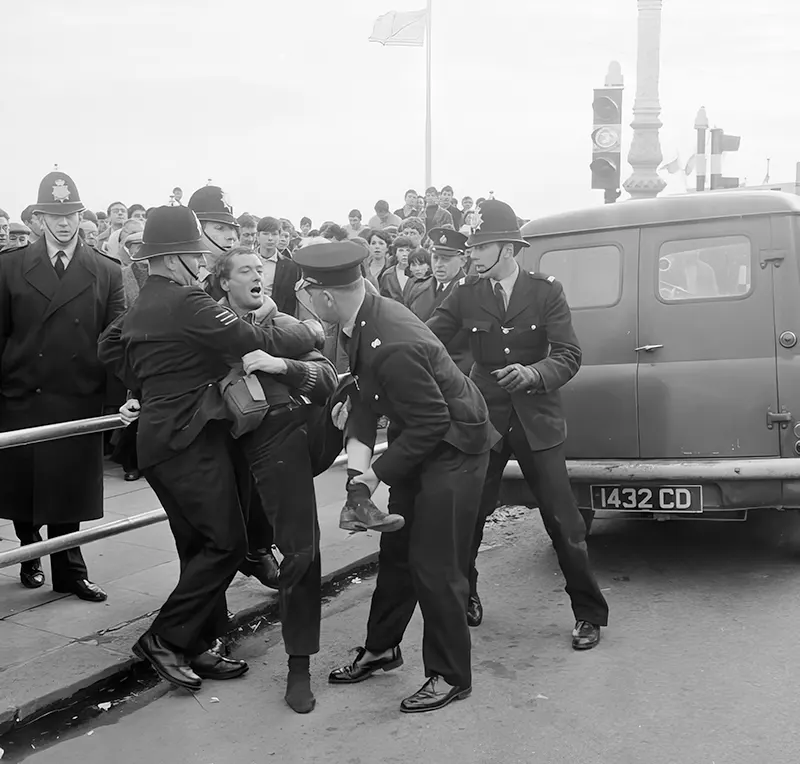
A knot of uniformed police officers wrestles a young man toward the curb, their gloved hands locked around his arms as he twists and shouts in defiance. The figure being hauled away wears the telltale rocker look—dark, practical clothes and a hard-edged posture—while a line of onlookers crowds the promenade behind them, faces turned toward the commotion. Parked at the edge of the scene, a police vehicle and the stark geometry of railings and street fixtures frame the struggle, turning a split-second of disorder into a public spectacle.
Along Brighton’s seafront, the photo breathes the tense energy of 1965, when youth identity could be read in silhouette and stance as much as in fabric. Mods and rockers weren’t only labels; they were competing codes of fashion and belonging, acted out in tailored sharpness versus leather-and-denim bravado, scooters versus motorbikes, dance halls versus road culture. Here, that larger “style war” collapses into a single physical encounter, with law enforcement forced to intervene as a crowd watches for what happens next.
What makes the image linger is its mix of theatre and reality: authority in polished helmets and pressed uniforms, resistance in a body refusing to go quietly, and a seaside public space briefly transformed into an arena. The composition invites modern readers searching for Brighton, England 1965, mods and rockers, or 1960s British youth culture to see how fashion, class, and masculinity could collide in the open air. It’s an unvarnished reminder that style, in the mid‑sixties, was never merely decorative—it could spark confrontation, and it could draw a crowd.