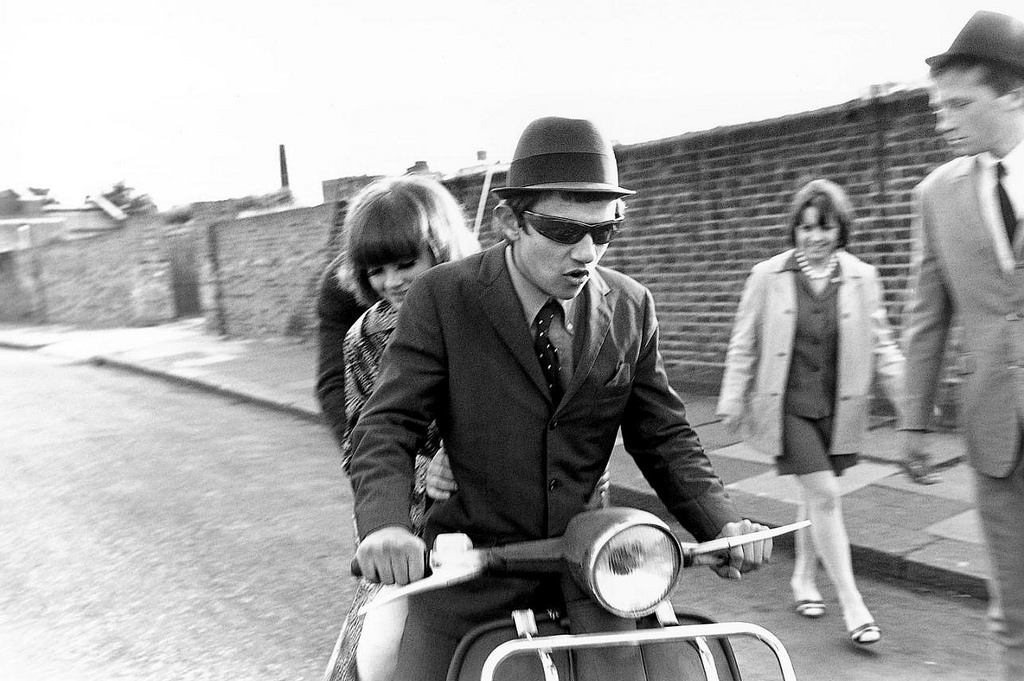
A sharply dressed young rider leans into the handlebars of a scooter, his narrow suit and tie set off by a dark hat and sunglasses that read as pure Mod attitude. Behind him, a passenger clings on, hair swinging with the motion, while the street blurs into brick walls and pavement—an everyday urban backdrop turned into a runway by speed and style. Even in monochrome, the scene hums with the crisp, controlled look that made scooters an emblem of 1960s youth culture.
Mods treated clothing as a statement of modernity: clean lines, tailored silhouettes, and a cool distance that contrasted with older, rougher ideas of masculinity. The scooter itself—compact, practical, and continental in spirit—became part of the uniform, a mobile extension of fashion as much as transport. Passing pedestrians in coats and smart dresses reinforce the era’s street-level elegance, where weekend rides and city corners could become stages for identity.
Linked to the broader “Style Wars” between Mods and Rockers, images like this capture the tension between conformity and rebellion playing out through fabric, grooming, and machines. Rather than a posed portrait, the candid movement suggests a lived-in subculture: friends on the move, eyes forward, image carefully assembled. For anyone searching the history of Mod fashion, scooters, and 1960s British street style, this moment distills the period’s mix of precision, swagger, and youthful momentum.