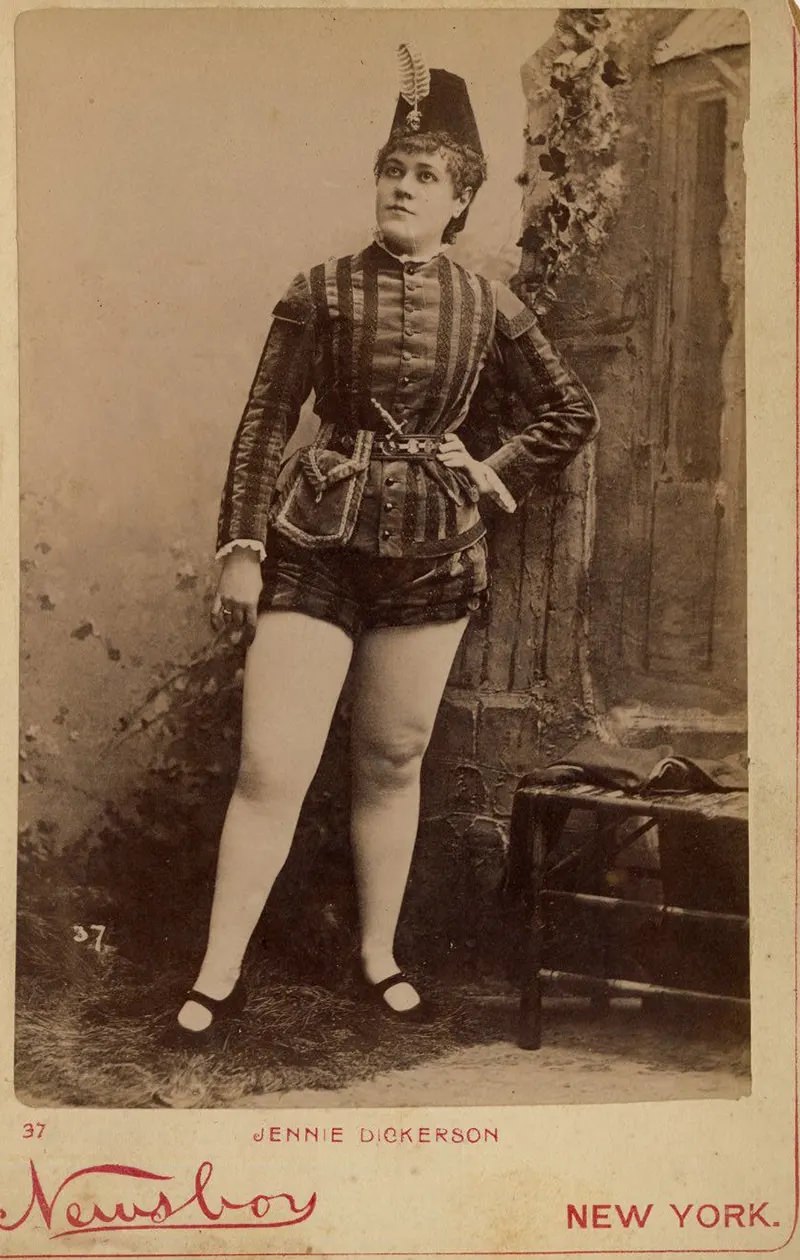
Jennie Dickerson poses with a confident, stage-ready stance, one hand set at her hip as if awaiting a cue from the wings. Her pseudo-military costume borrows the language of uniforms—striped jacket, tight-fitting sleeves, a cinched belt, and a small cap topped with a feather—yet it is unmistakably tailored for performance, with abbreviated bottoms and bare legs that break from everyday Victorian modesty. The studio backdrop, with its painted doorway and faux greenery, frames her like a theatrical heroine rather than a soldier on parade.
Costuming like this was a staple of Victorian burlesque and variety entertainment, where audiences delighted in familiar symbols turned playful and provocative. The “military” look offered crisp lines, shiny trim, and a disciplined silhouette, while also allowing performers to project boldness, wit, and modernity—qualities increasingly associated with the new female stage persona of the late 19th century. Dickerson’s direct gaze and squared shoulders sell the illusion of authority, even as the outfit’s cut signals spectacle and flirtation.
Details in the print add to its collectible, promotional feel: her name is printed beneath the image, along with “New York,” grounding the portrait in the commercial world of touring acts and theater publicity. The overall composition reads like an advertisement as much as a keepsake, meant to circulate beyond the performance itself and keep a performer’s image alive in the public imagination. For historians of fashion and culture, it’s a vivid glimpse into how entertainers used costume, posture, and studio photography to craft celebrity in the Victorian era.