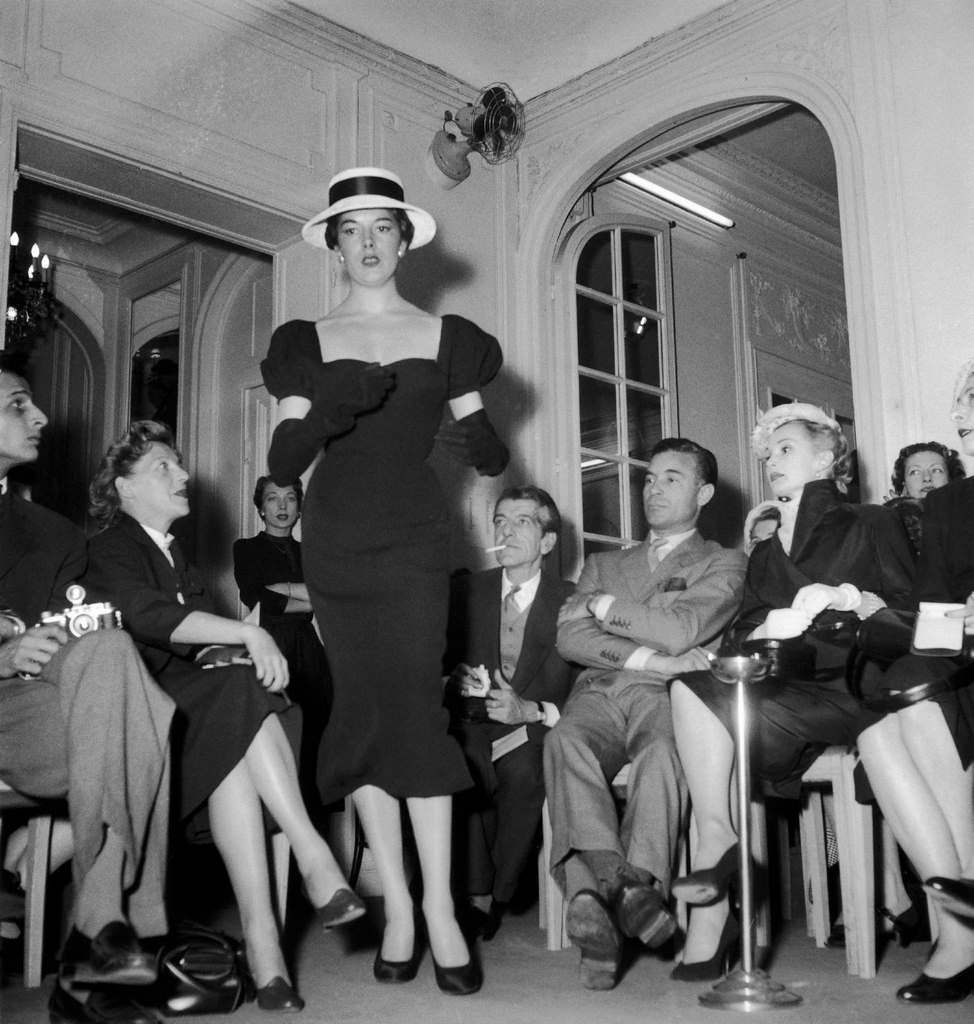
Paris in 1953 feels close enough to touch as a model advances through a crowded salon, framed by ornate molding, tall mirrors, and the bright glare of overhead lights. Her look is pure Jacques Fath: a sleek, body-skimming dark dress with a sculpted neckline, short puffed sleeves, and long gloves that sharpen the silhouette into something both formal and undeniably modern. A crisp boater-style hat tops the ensemble, adding a graphic note that draws the eye upward as she passes within arm’s length of the front row.
Around her, the audience becomes part of the scene’s drama—men in tailored suits, women in smart coats and carefully set hair, faces angled toward the runway with a mix of appraisal and delight. Seated so close their knees nearly meet the model’s path, they watch like theatergoers, caught between conversation and concentration. The tight arrangement of chairs and the intimate interior underline how mid-century haute couture shows were staged: not in cavernous venues, but in rooms where craftsmanship could be scrutinized stitch by stitch.
Beyond its immediate elegance, the photograph offers a window into postwar fashion culture, when Paris couture reclaimed its authority through precision, restraint, and impeccable line. Fath’s name carries the promise of glamour, yet the styling here also signals discipline—clean surfaces, controlled volume, and a confident walk that sells the garment as much as the cut does. For anyone searching vintage fashion photography, 1950s Paris style, or Jacques Fath fashion show history, this moment distills the era’s social ritual: clothes presented as art, witnessed at close range, and remembered long after the last step down the carpet.