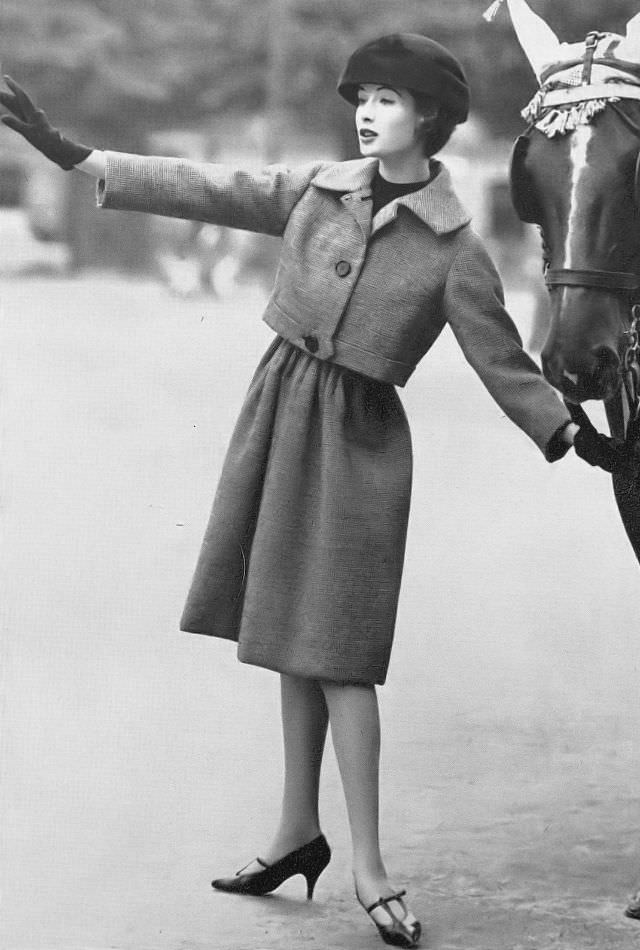
October 1958 places Gitta Schilling in the poised, forward-looking world of late-1950s fashion, wearing a tweed skirt and jacket by Guy Laroche. The outfit’s cropped jacket with oversized buttons and a wide collar sits neatly above a softly flared skirt, balancing structure and movement in a way that feels both practical and unmistakably couture. A rounded hat, dark gloves, and slim heels complete a look designed for the street as much as for the camera.
Her stance—one arm extended as if signaling across the roadway—adds a lively, candid energy that contrasts with the refined tailoring. Alongside her, a horse’s head and harness enter the frame, hinting at an urban scene where modern style and older modes of transport briefly share the same space. The blurred background keeps attention on texture and silhouette, letting the tweed’s subtle patterning and the clean lines of the ensemble do most of the storytelling.
For readers interested in mid-century fashion history, this photograph is a sharp example of how 1950s style evolved toward the cleaner, more architectural shapes that would soon define the next decade. It also serves as a vivid record of Guy Laroche’s design language—elegant, wearable, and meticulously finished—captured on a model whose composed expression and confident posture make the clothes feel alive. As part of a broader look at Gitta Schilling’s 1950s style, the image offers rich inspiration for anyone researching vintage couture, classic tailoring, or autumn fashion in the postwar era.