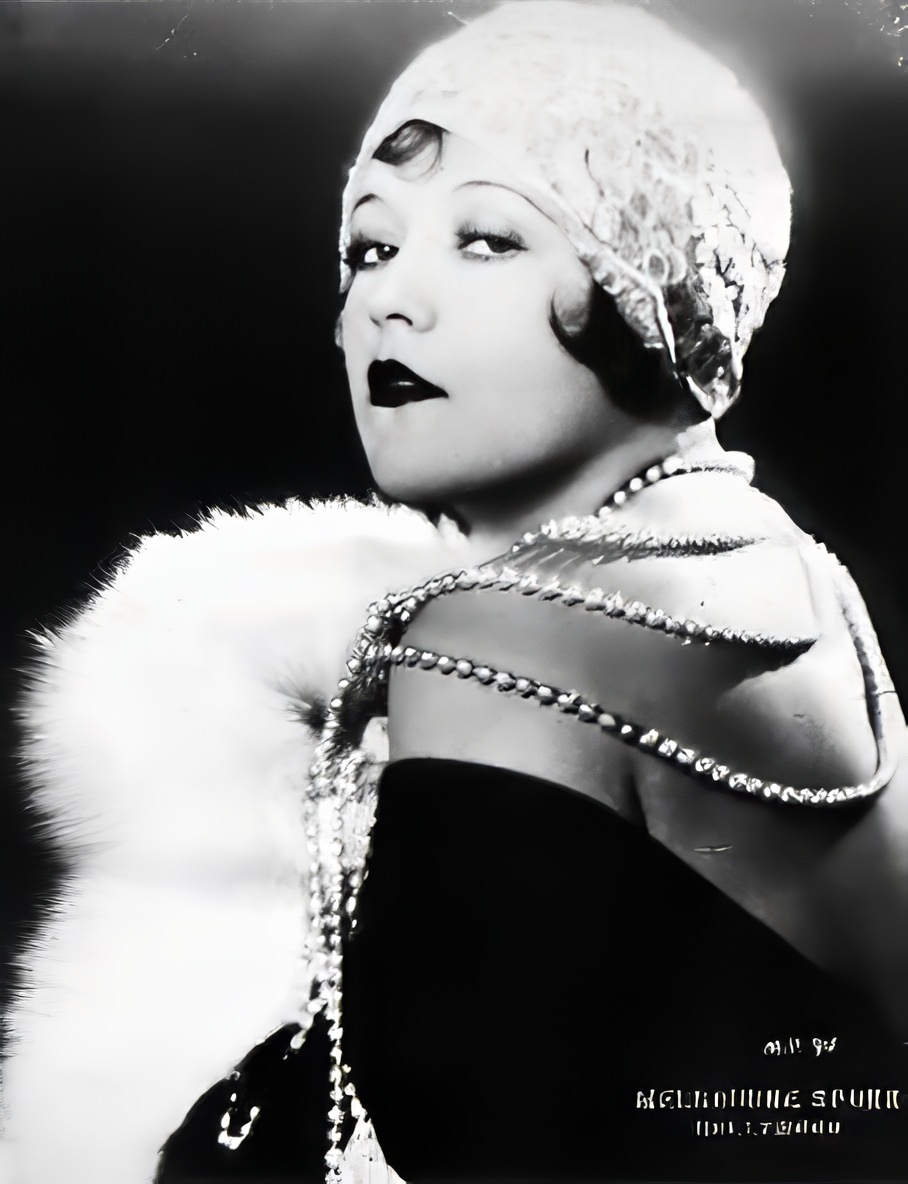
Poised in three-quarter profile, Marie Prevost meets the camera with a cool, knowing gaze that feels made for the spotlight. A close-fitting cloche-style cap frames her softly waved hair, while dark lipstick and carefully shaped brows heighten the dramatic, modern look associated with flapper-era glamour. The deep black background and high-contrast lighting turn her face into a stage, emphasizing the controlled confidence of a Hollywood studio portrait.
Feathered trim spills across the lower frame like a burst of luxury, balanced by strands of beads that drape over her bare shoulder in shimmering arcs. The styling speaks to 1920s fashion and culture—nights out, jazz-age rebellion, and the new freedom of women’s dress—yet it is also a carefully marketed image, designed to sell sophistication as much as beauty. Every texture, from fur to sequins, reads clearly in the crisp monochrome, inviting the viewer to linger on the details.
Behind the elegance lies a pivotal moment in film history, when performers had to recalibrate for the arrival of synchronized sound and the demands of talking pictures. Prevost’s star persona, shaped in the silent era, is suggested here through expressive makeup and a pose that communicates attitude without movement or dialogue. As a piece of classic Hollywood photography, the portrait doubles as a fashion document and a reminder of an actress who navigated the transition from silent films to talkies with notable ease.