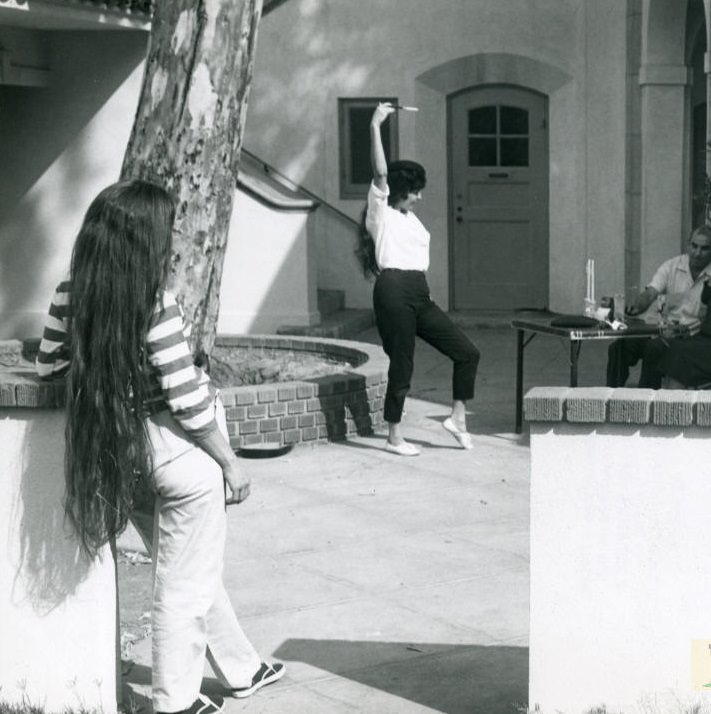
Sunlight spills across a simple courtyard, where a small gathering turns an everyday moment into something cinematic. In the foreground, a woman leans casually with astonishingly long hair cascading down her back, its shine and texture becoming the photograph’s quiet headline. Behind her, another figure strikes a playful pose near a brick planter and a tree trunk, while a seated onlooker at a table adds to the sense of lived-in spontaneity.
Stan Shuttleworth’s lens lingers on “flowing locks” not as a studio gimmick but as an emblem of style and self-expression, letting hair function like fabric—dramatic, mobile, and impossible to ignore. The contrast of crisp light and deep shadow gives the scene a specular sheen, emphasizing silhouettes, glossy strands, and the clean geometry of the architecture. Details like striped knitwear, tapered trousers, and relaxed footwear root the image in fashion as it was worn, not merely displayed.
For readers interested in vintage photography, women’s fashion history, and culture in transition, this post offers more than a striking hairstyle—it hints at changing attitudes toward beauty, freedom, and the public performance of identity. The courtyard setting, half social space and half stage, suggests a candid snapshot of a moment when personal style carried its own quiet defiance. “Flowing Locks” invites you to look closely at texture, posture, and light, and to consider how something as simple as hair could speak volumes in a single frame.