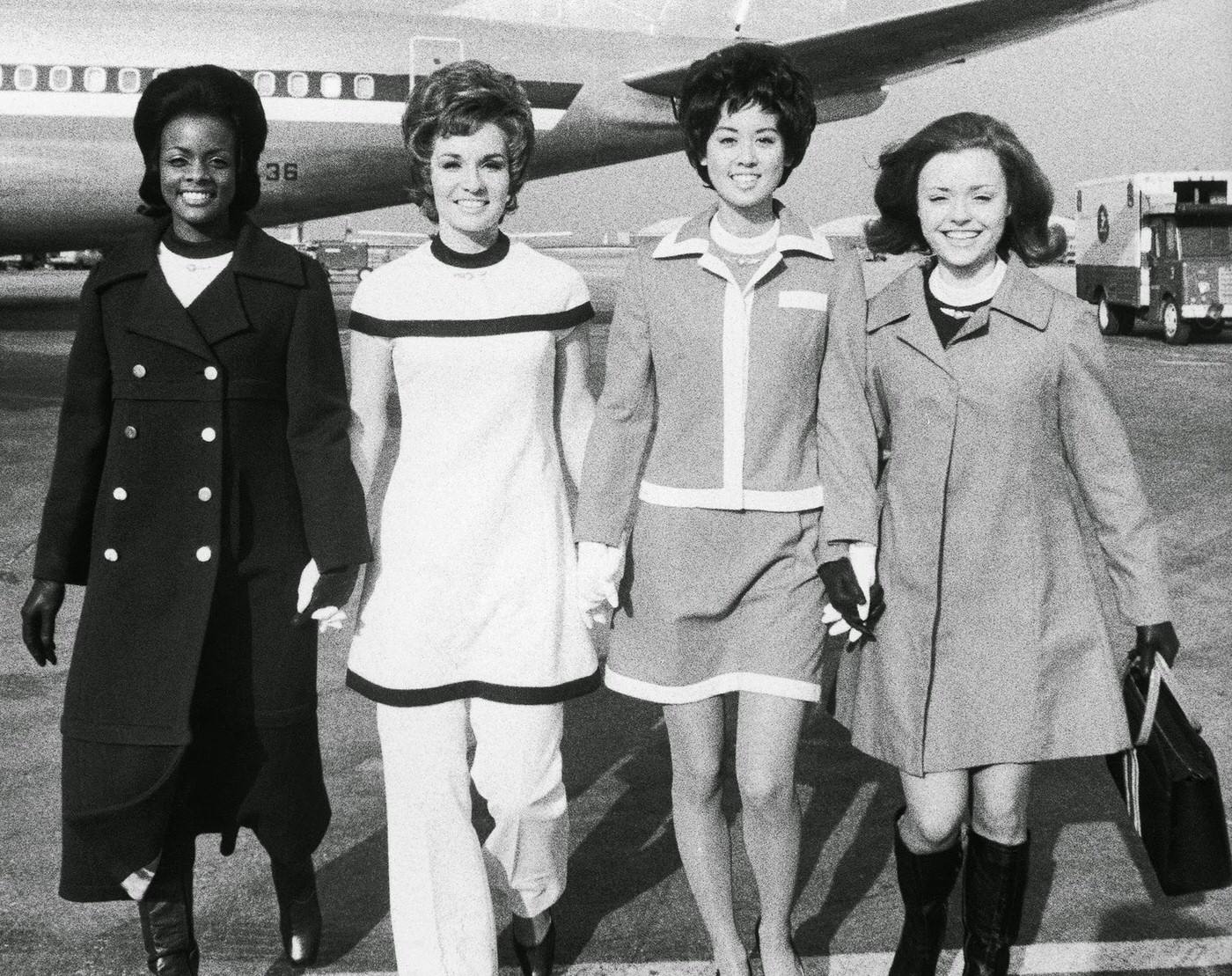
Four American Airlines stewardesses stride across the tarmac with the easy poise of women who know they’re being watched, smiling as they face the press in the mid-1970s. Behind them, a jetliner and ground vehicles frame the scene in unmistakable airport bustle, turning a simple walk into a public moment of airline branding. Their expressions read as confident and practiced, the kind of composure expected from a front-facing profession that blended hospitality with performance.
Fashion does much of the talking here: a double-breasted coat with bold buttons, a crisp mod-style mini uniform with contrasting trim, and a smart skirt-and-jacket set that signals the era’s streamlined corporate look. The mix of outerwear, gloves, hemlines, and accessories hints at changing standards—less about the strict, old-world formality of earlier decades and more about modernity, mobility, and camera-ready polish. Hairstyles and silhouettes root the photograph firmly in the 1970s, when airlines used uniform design to convey youth, efficiency, and contemporary glamour.
Air travel culture in this period was shifting, and moments like this reveal how stewardesses (today we’d say flight attendants) were positioned at the intersection of service work and public image. Their uniforms functioned as moving advertisements, while the runway setting underscores how much of airline life unfolded in view of passengers, photographers, and the broader media. For readers drawn to aviation history, women’s work, or mid-century-to-mod style, this photo offers a vivid snapshot of American Airlines’ look—and the larger story of how flight attendant fashion evolved from the Golden Age into a new, modern era.