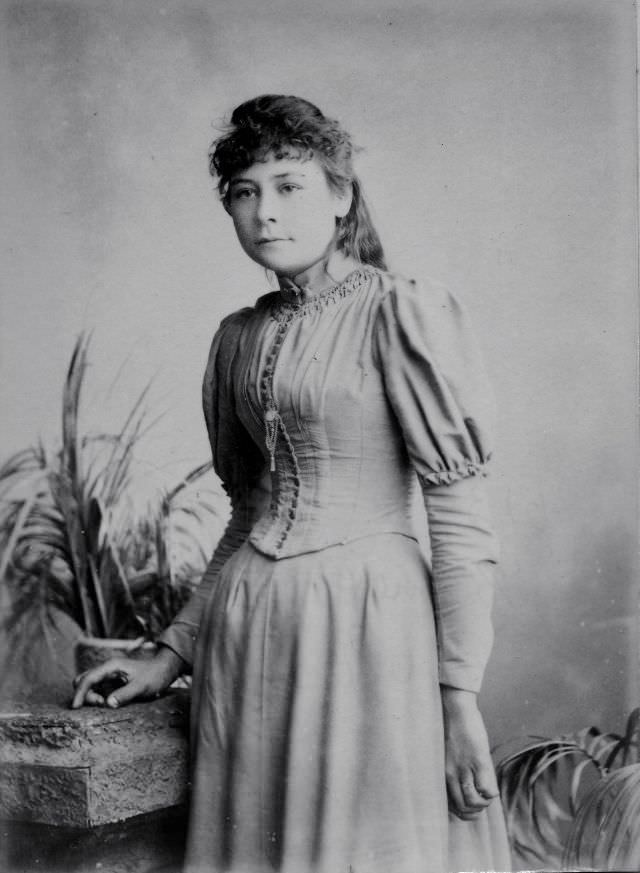
Soft studio light falls across a young Victorian woman as she stands beside a stone pedestal and a spray of potted greenery, the plain backdrop keeping attention on her silhouette. Her high-neck bodice with puffed sleeves narrows sharply at the waist, the tailored line suggesting the structured support of a tight corset beneath. A long skirt drops in gentle folds, while her calm, unsmiling gaze and carefully arranged hair reflect the formal etiquette of late 19th-century portrait photography.
Corsetry was more than a fashion choice in Victorian-era dress; it acted as an indispensable undergarment that shaped posture and created the period’s coveted hourglass figure. In portraits like this, the corset’s influence is read through the smooth front, the snug fit at the midsection, and the way the bodice and skirt hang from a disciplined waistline. Such images sit at the crossroads of beauty ideals and daily realities, hinting at the negotiation between comfort, status, and respectability that defined women’s clothing in the era.
Beyond the garments themselves, the photograph speaks to how people wanted to be remembered—composed, refined, and properly dressed according to contemporary standards. The decorative pendant at her throat and the subtle trim on the bodice add texture without distracting from the overall line, reinforcing the Victorian preference for controlled elegance. For readers exploring Victorian fashion history, tight corsets, and women’s culture of the late 19th century, this portrait offers a vivid example of how understructure quietly dictated the outer look.