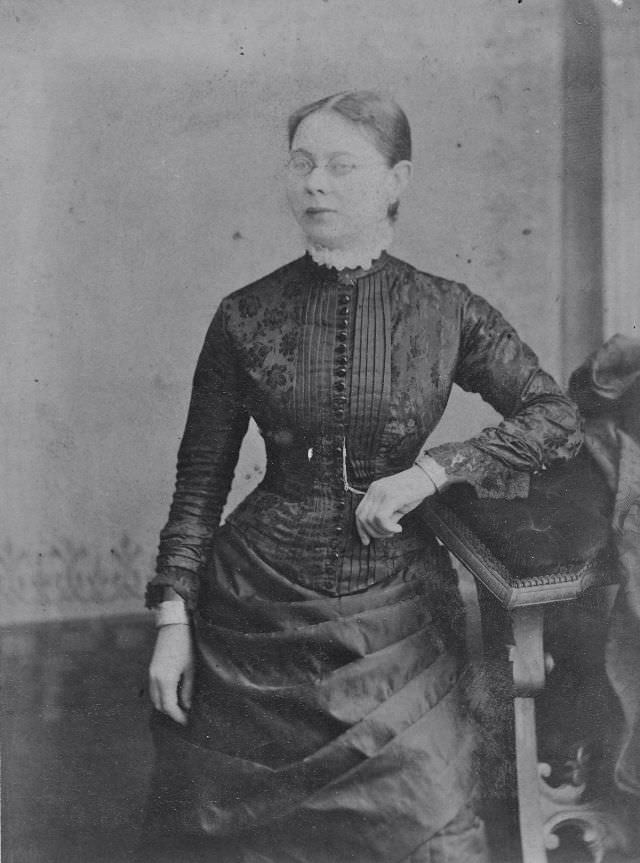
Poised beside a studio table, a Victorian woman holds herself with the practiced composure of late 19th-century portraiture, her gaze turned slightly away as if caught between patience and self-awareness. The fitted bodice draws the eye to a sharply defined waist, while the dark, patterned fabric and high neckline signal respectability and refinement. Details like the row of buttons, the subtle sheen of the dress, and the neatly arranged hair speak to the careful choreography behind formal photography in this era.
Corsetry—celebrated as an indispensable undergarment of Victorian fashion—shaped not only clothing but posture, silhouette, and the period’s ideals of femininity. Under the outer dress, a tight corset would have created the rigid, tapered line that allowed bodices to sit smoothly and skirts to fall in controlled folds. In images like this, the corset’s influence is visible even without being shown directly: the straight back, the lifted chest, and the disciplined stillness demanded by both etiquette and the camera’s lingering exposure.
Beyond style, the photograph hints at the daily negotiations between comfort, beauty, and social expectation that defined Victorian women’s dress. The studio setting—plain backdrop, supportive furniture, and a pose designed to appear effortless—frames the wearer as both individual and representative of a broader fashion culture. For modern viewers searching for Victorian corsets, tight-laced silhouettes, and authentic late 19th-century women’s clothing, this portrait offers a vivid window into how undergarments quietly engineered the era’s iconic look.