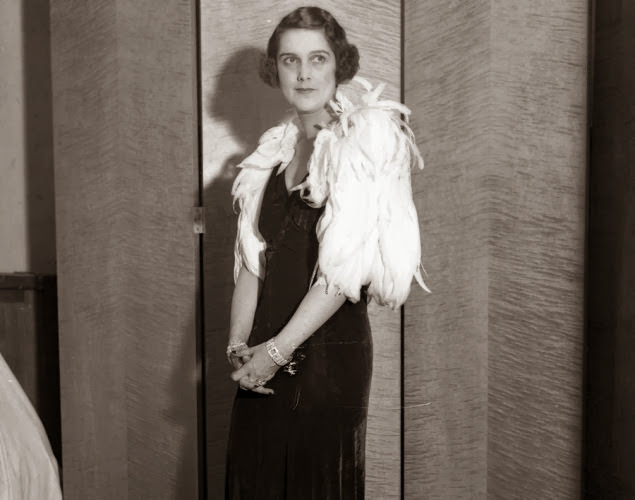
Feathers spill over the shoulders of a poised society model, turning a sleek black velvet evening gown into a full statement of 1930s glamour. The cape’s soft, pale plumes frame her neckline and arms, while the dress beneath remains simple and column-like, letting texture do the talking. With her hair set in smooth waves and her hands neatly clasped, the overall effect balances theatricality with restraint—exactly the sort of contrast that made formal fashion of the era so compelling.
Mrs. George Harris appears here in 1932, presented not as a distant mannequin but as a woman performing elegance for an audience at a society fashion show. Jewelry at the wrist and a refined neckline suggest carefully chosen accessories rather than excess, and the studio-like backdrop keeps attention on silhouette and materials. It’s a reminder that “red carpet” flair didn’t begin with modern celebrity culture; it was already being rehearsed in ballrooms and showrooms where designers tested how drama played in motion and under lights.
Long before pop icons made feathers a signature, fashionable circles were already exploring how a single extravagant layer could transform an evening look. For readers interested in 1930s fashion history—bias-cut influence, velvet’s rich sheen, and the rise of professional modeling—this photograph offers a crisp snapshot of style as social performance. The feather cape reads both timeless and of its moment, capturing the era’s appetite for luxury during a decade when appearances still mattered, perhaps all the more because of the world beyond the gown.