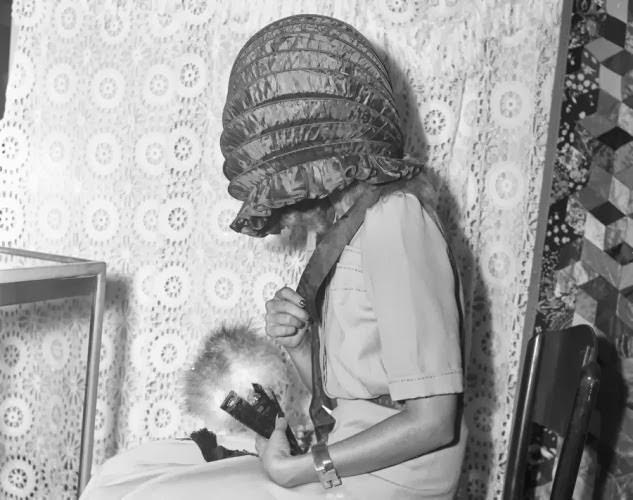
A folding bonnet takes center stage here, arcing forward like a miniature canopy and turning a fashion pose into a playful act of concealment. The model’s face nearly disappears beneath the layered structure, leaving viewers to read the scene through silhouette, texture, and attitude instead. Against a patterned backdrop, the bonnet’s repeated bands and soft trim feel deliberately theatrical—proof that headwear could be the headline, not an accessory.
Up close, the styling invites a closer look at materials and contrast: a crisp short-sleeved blouse, a smooth bracelet at the wrist, and a plush, furry accent resting across the lap. The model’s hands seem to frame the moment, one holding the garment and the other lifting a dark object that adds a hint of everyday life to the set. Even without eye contact, the composition feels intimate and candid, like a behind-the-scenes glimpse into how fashion imagery was staged.
Fashion history lovers will recognize the quiet shift suggested by the title: in 1941, bold millinery and clever construction could outshine the traditional emphasis on a model’s features. The bonnet’s dramatic fold-forward design speaks to a culture of ingenuity—style that protects, transforms, and entertains all at once. For readers exploring 1940s fashion, vintage modeling, and the evolution of accessories, this photograph offers a memorable reminder that sometimes the most captivating “face” in the frame is the hat.