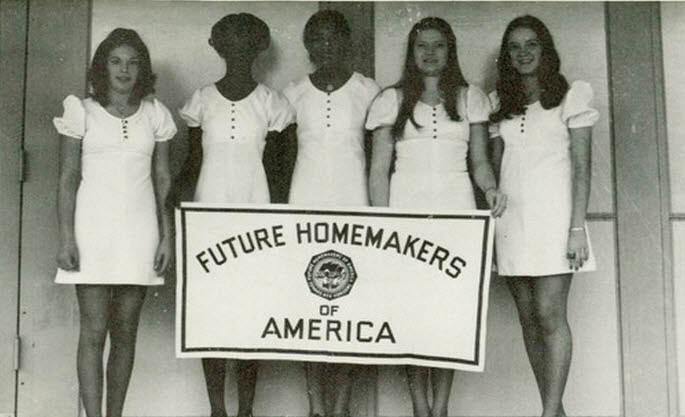
Five students stand in a straight line behind a bold banner reading “Future Homemakers of America,” their matching uniforms doing as much talking as their composed expressions. The dresses are stark white with short puff sleeves and a neat row of buttons, cut in a way that echoes the era’s fascination with streamlined silhouettes and shorter hemlines. Captured against a plain wall like a school hallway or stage backdrop, the scene feels formal, club-like, and unmistakably rooted in mid-century-to-late-20th-century school life.
Uniform fashion here isn’t just about sameness; it’s a snapshot of how youth culture and dress codes negotiated space during the miniskirt years. The identical outfits suggest an organization that prized cohesion and presentation, yet each student’s hair and stance adds small variations that hint at personality within the rules. In a single frame, the photo bridges two stories—traditional expectations of “home” training and the changing look of girls’ fashion as hemlines rose and silhouettes simplified.
For anyone searching vintage school uniform photos, the image works as a crisp reminder that clothing can be both a requirement and a cultural signal. The “Future Homemakers of America” banner anchors the moment in a specific kind of American extracurricular life, when clubs and programs helped define what education was meant to produce. Seen today, the combination of minidress-like uniforms and a homemaking title reads like a time capsule of shifting ideals—part school pride, part fashion history, and part social commentary preserved in silver and shadow.