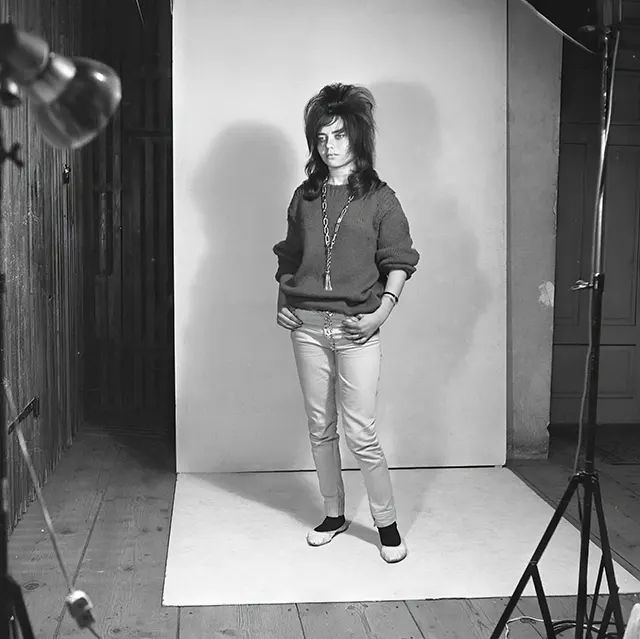
In a bare-bones studio setup, a young model stands on a paper sweep with a steady, confrontational poise, framed by the visible lighting stands and the scuffed wooden floor. The candid inclusion of equipment turns the fashion moment into a behind-the-scenes document, reminding the viewer that youth style was being staged, tested, and recorded. Her direct gaze and hands-on-hips stance carry the self-assurance often associated with rebellious postwar street culture.
Clothing does most of the talking: a slouchy knit sweater worn loose over slim, light-colored trousers, finished with dark flats and a long pendant necklace that draws the eye down the silhouette. The towering, teased hairstyle reads as an intentional statement—part glamour, part defiance—suggesting a young person using fashion to claim space and identity. Even without a crowd or city backdrop, the look evokes the “Halbstarken” attitude celebrated in vintage photos of youth subcultures: sharp lines, bold hair, and an air of refusing to blend in.
What makes the scene compelling is the tension between plain surroundings and expressive styling, a contrast that highlights how fashion becomes culture rather than mere clothing. The minimal backdrop isolates the figure like a specimen of an era, turning sweater, jewelry, and hair into visual keywords for anyone searching mid-century youth fashion, European street style, or the history of rebellious teenagers. Taken as a whole, the photo reads like a small manifesto—proof that attitude can be tailored, accessorized, and photographed into memory.