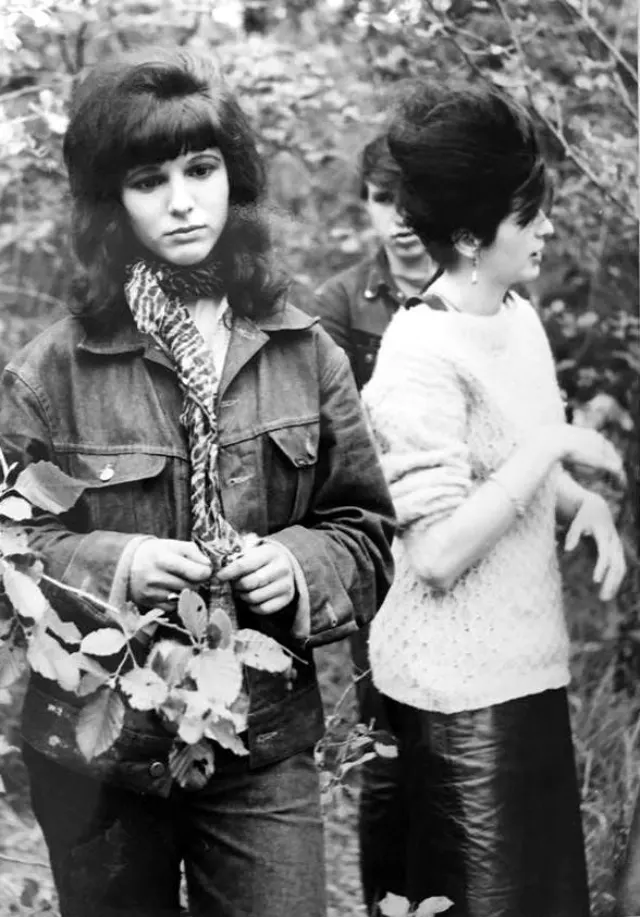
Away from the adult gaze, a small group of youngsters lingers at the edge of overgrown brush, their faces set with the cool self-possession that made the Halbstarken so memorable. The foreground figure’s heavy fringe, long hair, and steady stare give the scene its emotional anchor, while leaves and branches frame the moment like an improvised stage. It’s a quiet, candid slice of youth culture—less about where they are than about who they are trying to be.
Clothing does much of the talking: a sturdy denim jacket with bold seams and pockets, a patterned scarf knotted close to the neck, and an outfit built for attitude as much as for weather. To the right, a beehive-style coiffure and soft knit sweater meet sleek, shiny trousers, a mix of textures that reads as deliberately modern and slightly defiant. Even without a street corner or café sign to place them, the fashion signals a generation experimenting with silhouettes, hair, and accessories as portable declarations.
Between the foliage and the casual poses, the photograph hints at the push-and-pull of postwar youth identity—belonging to a group while insisting on individuality. The Halbstarken look wasn’t only about toughness; it also carried a keen awareness of style, borrowed influences, and the thrill of standing out. For readers searching vintage fashion, European youth subcultures, or Halbstarken style, this image offers a compact lesson in how clothes, hair, and stance could turn everyday teenagers into icons of cultural change.