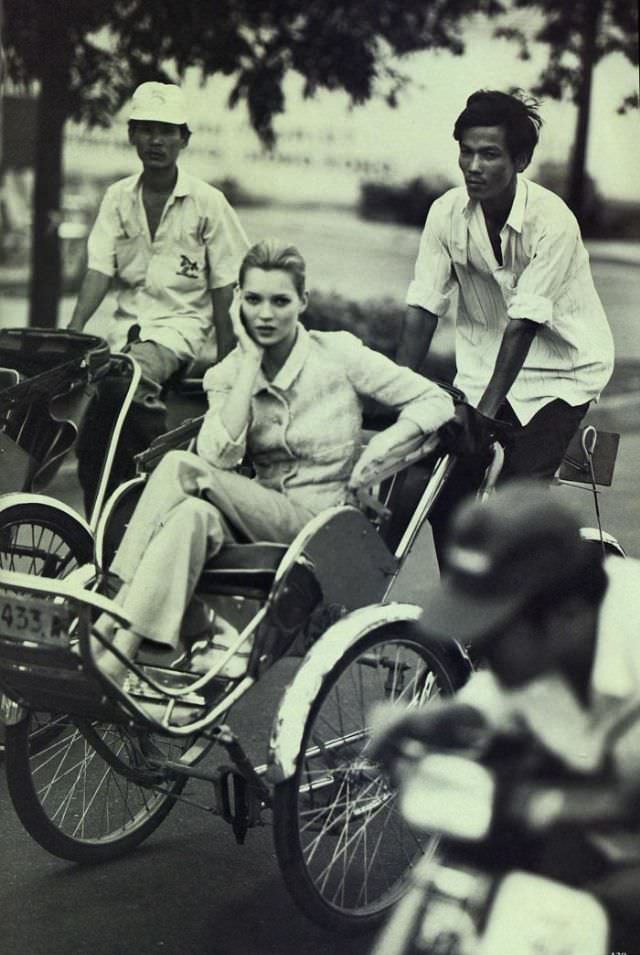
Lean and watchful, a young blonde model sits sideways in a cycle rickshaw, her chin propped in her hand as traffic blurs past in the foreground. Two men flank the vehicle—one perched behind in a light cap, the other standing at the shafts—framing her pale outfit against a soft haze of roadside trees and open air. The grainy, high-contrast monochrome lends the scene a documentary edge, as if fashion has slipped into the street and borrowed the city’s everyday rhythm.
Bruce Weber’s camera turns a Vogue fashion story into something that feels like film stills, echoing the title’s “Good Morning Vietnam” reference through mood rather than literal costume. The model’s crisp, utilitarian tailoring—rolled sleeves, clean lines, and an unadorned silhouette—reads like travel wear designed for heat and motion, while her steady gaze keeps the glamour intact. Around her, the rickshaw’s spokes, handlebars, and curved frame create a lattice of geometry that pulls the eye from face to fabric to street.
As a piece of 1990s fashion culture, the photograph thrives on contrast: editorial poise set against a working vehicle, studio polish against ambient dust and distance. It’s an image built for SEO-friendly fascination—Kate Moss, Vogue US, Bruce Weber, June 1996—yet it also functions as a broader snapshot of how magazines mined cinema, travel, and reportage aesthetics to refresh luxury storytelling. What lingers is the tension between staged elegance and real-world context, captured in a single, cinematic pause.