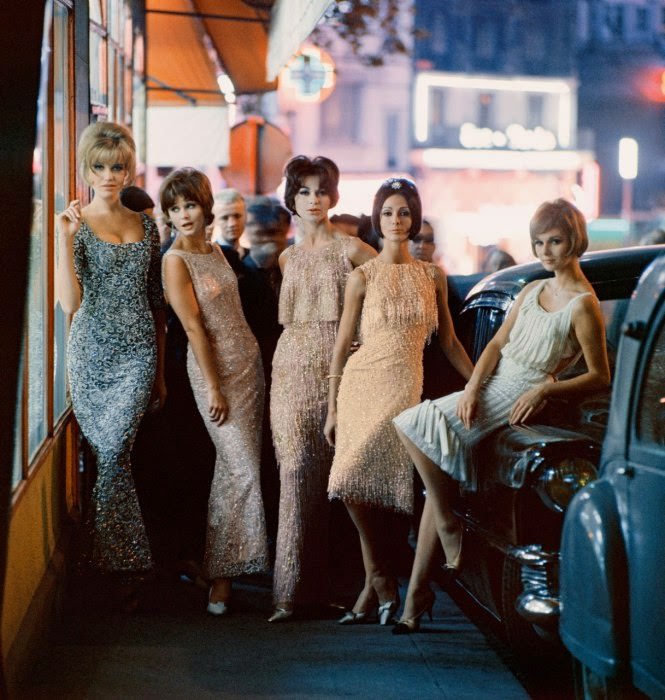
Under a glowing street awning, five poised models turn the sidewalk into a runway, their cocktail and column gowns catching every hint of evening light. Sequins, beadwork, and metallic threads create a liquid shimmer across fitted silhouettes, while sculpted bouffant hairstyles and sleek accessories push the look firmly into early‑1960s glamour. A parked car at the curb and blurred signage in the background add a cinematic, after-dark energy that feels both candid and carefully staged.
The title points to the Ondine and Ciel de Feu dresses from the Autumn–Winter 1961 haute-couture collection, and the styling matches that moment’s fascination with sparkle, clean lines, and modern femininity. Here, couture isn’t presented behind velvet ropes; it’s placed in the urban night, where reflections on fabric echo the city’s own neon and headlights. The mix of a floor-length, body-skimming gown with shorter, fringe-like textures suggests a wardrobe designed for movement—dancing, arriving, being seen.
Fashion historians often read images like this as more than a lookbook: they’re snapshots of how couture marketed desire, confidence, and social ritual in the postwar decades. For readers searching haute couture 1961, vintage fashion photography, or classic evening dress inspiration, this scene offers a rich visual record of craft and attitude—glittering surfaces backed by meticulous construction. The result is timeless style with a specific cultural pulse, balancing elegance with the thrill of the street.