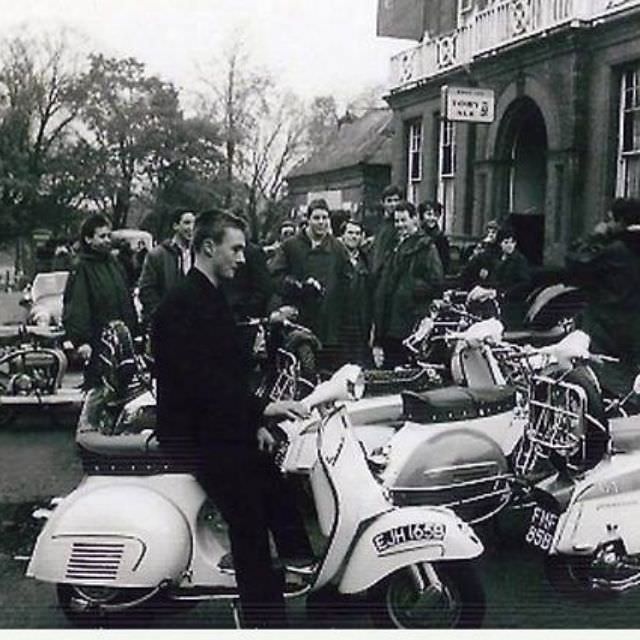
Parked scooters crowd the curb outside a large building, their chrome mirrors and curved cowls catching the light as young men linger in a loose semicircle. A rider in a dark jacket sits astride a pale scooter in the foreground, while others cluster behind him in heavy coats, watching and talking as if the street itself were a stage. The scene has the restless, public energy of 1960s youth culture, where a machine could signal belonging as clearly as any badge or haircut.
In the style wars between Mods and Rockers, fashion wasn’t decoration—it was a declaration, and this gathering reads like a snapshot of that coded language. The neat, scooter-centered look associated with Mod culture stands out: compact bikes lined up with care, riders dressed to appear sharp even in cold weather, and an air of urban cool that favors polish over roughness. Nearby, the faces in the crowd suggest curiosity and challenge in equal measure, hinting at how quickly these subcultures could turn from pose to provocation.
Beyond the personal drama, the photograph doubles as a document of mid-century street life, capturing how public spaces became meeting points for music, style, and identity. Every detail—the tight formation of scooters, the attentive onlookers, the practical outerwear—speaks to a moment when fashion and transport blended into a single statement. For readers searching the history of Mods and Rockers, 1960s fashion culture, and classic scooter style, the image offers a vivid, lived-in glimpse of the era’s rivalry and allure.