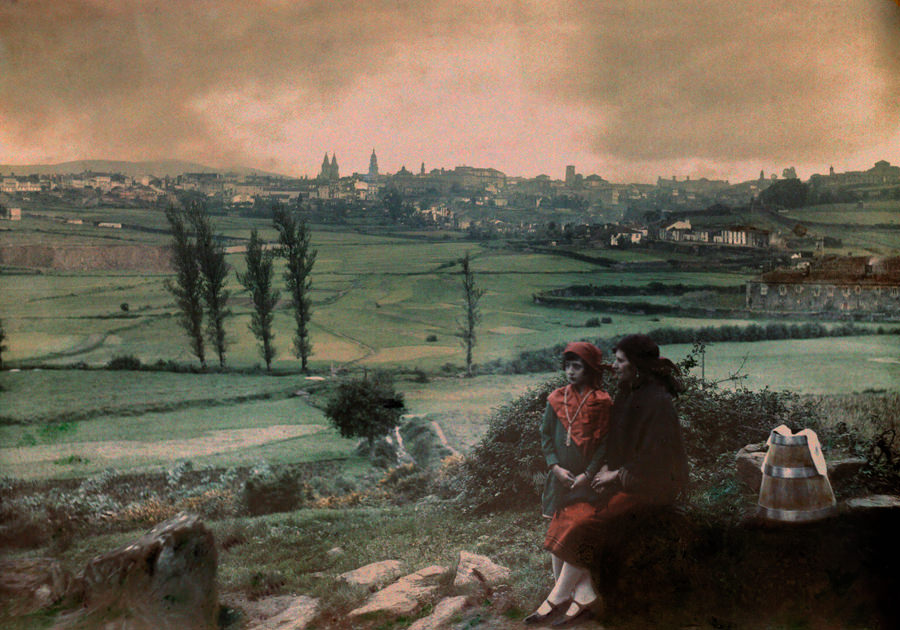
From the fountain of Santa Maria, the city of Santiago de Compostela stretches across the horizon in 1929, its familiar towers and clustered rooftops rising beyond a broad sweep of fields. The scene reads like a map made of light and weather: low farmland broken into soft bands, a few tall trees punctuating the open ground, and a heavy sky that presses the skyline into sharp relief. It’s a view that balances the monumental with the everyday, reminding us how closely the historic center once sat against working countryside.
In the foreground, two women pause on a stone edge, their clothing drawing the eye with deep tones and clean silhouettes that evoke late-1920s fashion without needing spectacle. One wears a cloche-style hat and a bright coat or dress, while the other is wrapped in darker outerwear, the pair posed in quiet conversation as if taking in the panorama. Their presence turns the landscape into lived space—an afternoon outing, a moment of companionship—rather than a distant postcard.
Details at the margins add texture to this historical photo of Spain: a small metal container rests nearby, and faint smoke or mist lingers over the fields, hinting at domestic routines and seasonal work. As a piece of visual history, the image offers both travel and cultural context for Santiago de Compostela, pairing a celebrated city view with the intimate scale of street life and dress. For readers interested in 1920s fashion, daily life, and the evolving relationship between city and countryside, this 1929 vantage point is rich with atmosphere.